
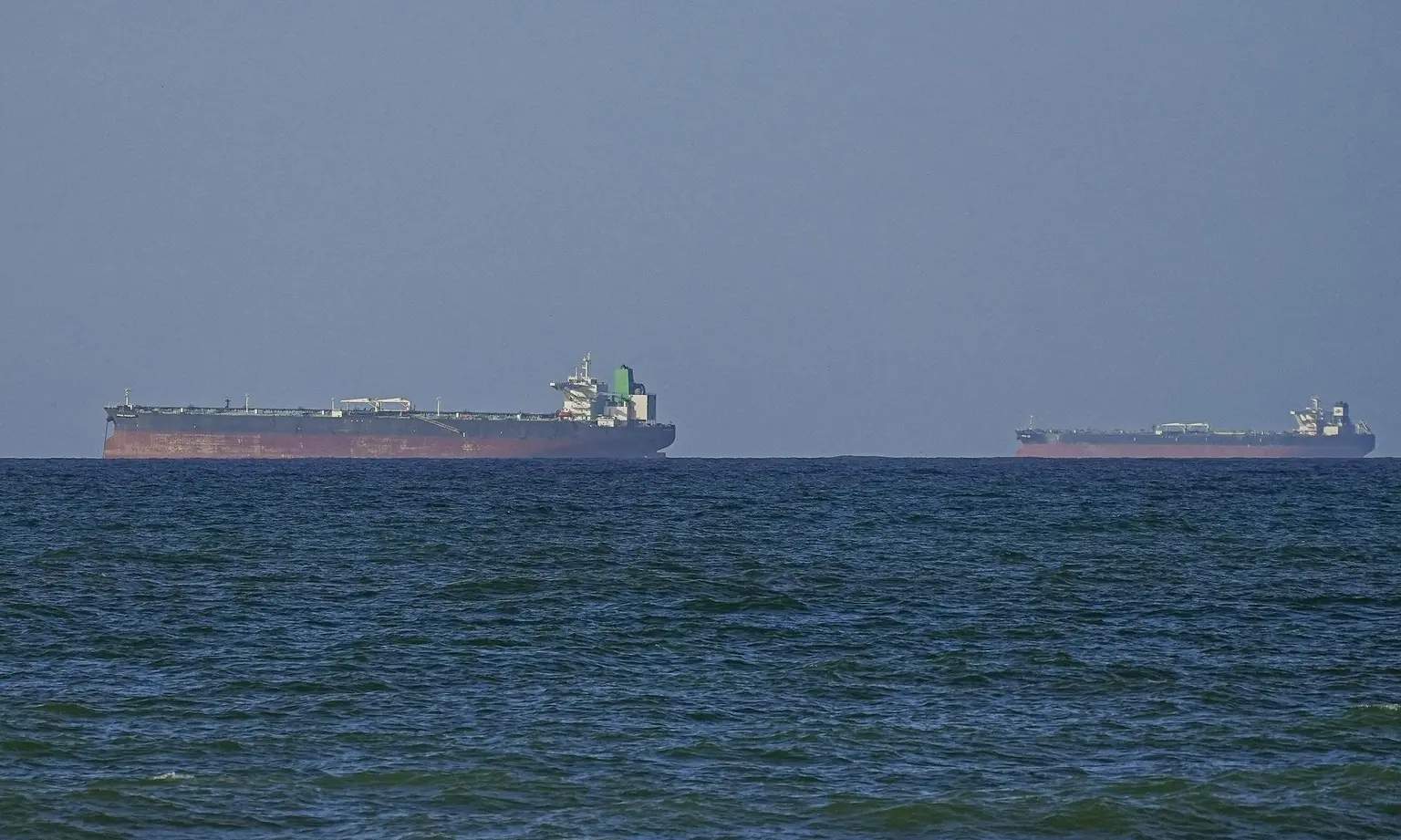
On July 25, Ukrainian long-range drones streaked more than a thousand kilometers from the front lines to strike vessels in the Caspian Sea — the world's largest inland body of water — hitting cargo ships carrying Iranian military supplies and a Russian warship. One Iranian sailor was killed. Another was wounded. Iran's Foreign Minister Abbas Araghchi warned that the attack "CANNOT GO UNANSWERED." Within hours, pro-Iranian Telegram channels circulated maps showing the entirety of Ukraine sitting within range of Iran's Khorramshahr-4 ballistic missile system.
This is not a story about a single strike on a single ship. It is a story about how two separate wars — Russia's invasion of Ukraine and the US-Israeli confrontation with Iran — have merged into one interconnected conflict, with a working-class sailor paying the price for the decisions of generals, oligarchs, and presidents thousands of kilometers away.
What Was Hit
The Security Service of Ukraine (SBU) identified the targets in a Telegram statement: the cargo ship Port Olya 2 (IMO 9481881), the dry cargo ship Begey (IMO 8943210), and a Russian Project 12418 Molniya-class missile boat. Ukrainian long-range drones also struck the Filanovsky field oil platform operated by Russian energy giant Lukoil.
| Target | Type | Status | Operator |
|---|---|---|---|
| Port Olya 2 | General cargo ship | Struck | MG-Flot (Russia), sanctioned by US (OFAC) |
| Begey | Dry cargo ship | Struck | Russian-flagged, sanctioned by UK (OFSI) and Canada |
| Project 12418 Molniya-class | Russian missile boat | Struck | Russian Navy |
| Filanovsky oil platform | Lukoil offshore facility | Struck | Russian energy infrastructure |
Ukraine's ambassador to Israel, Yevgen Korniychuk, revealed in a Sunday interview with N12 that the vessels hit by Ukraine contained components for drones and missiles destined for Iran. Both Port Olya 2 and Begey had documented histories of calling at Iranian ports including Amirabad, Nowshahr, Astara, and Bandar Anzali — the primary hubs for the Iran-Russia military supply chain across the Caspian.
The Iranian government has not released the name, flag, or IMO number of the vessel on which the sailor was killed. Reports indicate the ship was hit on the bridge and was damaged severely enough to require rescue by maritime authorities in Astrakhan, the Russian port city at the northern end of the Caspian. The identity of the dead sailor — one more working person swallowed by an industrial war machine — remains unreported.
The Caspian Sea: A Landlocked Battlefield
The Caspian Sea is bordered by five nations: Russia, Iran, Kazakhstan, Turkmenistan, and Azerbaijan. It is landlocked. Its waters cannot reach the open ocean. Under international convention, it is not technically a sea at all — it is the world's largest lake. That geographic reality makes Ukraine's strike extraordinary: these are not international waters where naval powers routinely operate. This is a confined body of water surrounded by states with competing claims, now transformed into a corridor of war.
Russia received its first batches of Iranian Shahed-136 attack drones via the Caspian early in the invasion of Ukraine, and has since established domestic production plants to manufacture Russian variants. The route is simple: Iranian ports like Bandar Anzali and Amirabad on the southern Caspian coast load military cargo onto vessels that cross northward to the Russian ports of Astrakhan, Makhachkala, or Kaspiysk. From Astrakhan, cargo enters the Volga-Don canal system — Russia's internal waterway connecting the Caspian to the Black Sea and the Sea of Azov.
This is not new traffic. The Caspian has long functioned as what analysts call a "shadow fleet" — vessels operating between Russian ports like Astrakhan and Makhachkala and Iranian ports such as Bandar Anzali, often with AIS (automatic identification system) transmission gaps near port approaches to mask their movements. But the volume and nature of the cargo has intensified dramatically since Russia launched its full-scale invasion of Ukraine in February 2022.
In January 2025, Iranian social media images showed air defense systems and truck-mounted Fatah-360 tactical ballistic missile launchers at the dockside at Bandar Anzali, awaiting loading. Those Fatah-360s were part of a Russian order for 220 such systems — launchers comparable in capability to the US-made M142 HIMARS that Washington has shipped to Ukraine. Iran sells weapons to Russia; Russia uses them against Ukraine; the United States arms Ukraine; Ukraine now strikes the Iranian supply chain. The circularity is the point. This is not a chain of events. It is a loop.
The Web of Imperial Alliances
Zelensky used the occasion to expose what he called a direct quid pro quo between Moscow and Tehran. In his evening address on July 25, he alleged that Russia has been passing satellite surveillance data to Iran to enable Iranian military operations in the Middle East — including strikes on US-allied Gulf states.
"There is a clear correlation between Russia's satellite imagery of these sites and Iranian strikes," Zelensky stated, pointing to Russian satellite observation of airbases in Bahrain, Jordan, and Kuwait between July 19 and July 20 — observations that preceded Iranian attacks on those same locations.
The details frame a layered exchange: Iran provides Russia with Shahed drones, missile components, and Fatah-360 launchers via the Caspian. Russia reciprocates by providing Iran with satellite intelligence to guide its own military campaigns across the Middle East. Meanwhile, the United States has conducted 13 consecutive nights of airstrikes on Iran before halting for a diplomatic window. CENTCOM maintains a naval blockade against Iranian shipping, having disabled two non-compliant vessels and boarded two more as of July 25. US President Donald Trump has paused further military escalation amid concerns over depleting Patriot interceptor stockpiles.
Trump himself claimed on Truth Social that both Vladimir Putin and Xi Jinping assured him they would not sell weapons to Iran. "If they did, it would be very bad for them," he added. The credibility of that assurance is, of course, another matter entirely — one undermined by the documented flow of Iranian weapons through the Caspian that Ukraine's strike was designed to disrupt.
Ukraine's calculus in striking the Caspian is not difficult to read. Kyiv is demonstrating its value to Western partners by putting pressure on Iran at a moment when Washington is seeking leverage in its own confrontation with Tehran. Ukraine has also been building security ties with Gulf states — Saudi Arabia, the UAE, and Qatar — offering anti-drone expertise in exchange for diplomatic support. Striking Iranian military logistics serves all those relationships simultaneously.
Historical Precedent: Ukraine's Caspian Campaign
The July 25 operation was not Ukraine's first strike in the Caspian. The escalation has been building for months:
| Date | Target | Outcome |
|---|---|---|
| August 2025 | Port Olya 4 (dry cargo ship) at Russian port of Olya | Destroyed; loaded with Shahed-136 components and Iranian munitions; halted Caspian hub operations for ~1 week |
| November 2024 | Russian naval vessels at Kaspiysk (Gepard-class frigates Tatarstan F691, Dagestan F693) | Damaged by Ukrainian drones |
| November 2024 | Iranian Northern Fleet at Bandar Anzali (flagship IRINS Deylaman F78, Sina-class fast attack craft) | Sunk in harbor — effectively eliminated Iran's Caspian naval defense capability |
| July 25, 2026 | Port Olya 2, Begey, Molniya-class missile boat, Filanovsky platform | Struck; one Iranian sailor killed |
The November 2024 strikes were particularly devastating for Iran's naval posture in the Caspian. The sinking of the frigate Deylaman and most of the Northern Fleet's fast attack craft in the harbor at Bandar Anzali eliminated Iran's ability to defend its own shipping in these waters. Since then, Iranian vessels crossing the Caspian have been essentially defenseless — sitting ducks for the kind of long-range drone strikes Ukraine executed on July 25.
Iran's Response: From Diplomacy to Threatened Retaliation
Iran's official reaction has moved through predictable channels — diplomatic protests, summoned ambassadors, appeals to the European Union and the UN Security Council. Araghchi called the strike "an absolutely illegal and unjustified act" and warned that the consequences would be "unforeseen." Iran's Foreign Ministry spokesperson Esmaeil Baghaei stated that Kyiv "must certainly be held accountable."
But the more revealing response has come from unofficial channels. The pro-Iranian Telegram channel Middle East Spectator published a map asserting that the entirety of Ukraine falls within the operational range of Iran's Khorramshahr-4 ballistic missile. The messaging has not been corroborated by official Iranian government sources — but it has not been disavowed either. In the ecosystem of Iranian state-adjacent media, these signals are not random.
Key specifications of the Khorramshahr-4 system:
- Estimated range: 2,000 km (sufficient to reach any target in Ukraine from Iranian territory)
- Type: Medium-range ballistic missile with maneuverable reentry vehicle
- Warhead: Estimated 1,500 kg
- Status: Not yet confirmed in active service; public testing reported
The distance from the Iranian coast of the Caspian to Kyiv is approximately 1,800 km. The distance to Ukraine's westernmost point near Lviv is roughly 2,200 km. Depending on launch point and the Khorramshahr-4's actual demonstrated range, a significant portion — potentially all — of Ukrainian territory could be at theoretical risk.
Analysts have suggested Tehran's retaliation options extend beyond missile strikes. They include:
- Targeting Ukraine-linked vessels in international waters
- Formally recognizing Russia's annexation of Crimea and the Donbas
- Accelerating arms shipments to Moscow — including more Shahed drones and Fatah-360 systems
- Providing Russia with more advanced satellite intelligence
Hamidreza Azizi, a visiting fellow at the German Institute for International and Security Affairs, wrote that analysts in Tehran share concerns that "Iran's confrontation with the United States, the Saudi-Houthi conflict and Russia's war against Ukraine are becoming increasingly intertwined." As he put it: "With each passing day, the war is evolving into an increasingly complex, multidimensional, and international conflict."
The Human Cost: A Name We Don't Know
One Iranian sailor is dead. His name has not been released. Iranian state media reported that another was injured. The ship, whatever its registration, had a crew of ordinary people — not generals, not intelligence chiefs, not the men who ordered Shahed drones dispatched to Ukrainian cities or approved satellite surveillance of Gulf airbases. A working sailor on a cargo vessel in a landlocked sea was killed by a drone launched from a country fighting a war he had no part in starting.
This is the machinery of the military-industrial complex at its most literal. Weapons flow from Iran to Russia. Russia shares intelligence with Iran. The United States arms Ukraine and bombs Iran. Ukraine strikes Iranian ships in the Caspian. Every link in the chain is justified by the previous one. Every actor claims self-defense. And at the bottom of it all, a sailor who was probably not a combatant by any reasonable definition is a casualty in a war he never chose — just as the civilians killed by Shahed drones over Odesa and Kharkiv never chose theirs.
The Caspian Pipeline Consortium: Why Washington Is Nervous
There is another dimension to this story that demands attention. The same Caspian waters where Ukraine struck Iranian military logistics are home to the Caspian Pipeline Consortium (CPC) — a network that transports approximately 2% of daily global crude oil from Kazakhstan through Russia to the Black Sea terminal at Novorossiysk. Chevron holds a 15% stake in the CPC and a 50% interest in the highly productive Tengiz field.
The Trump administration has already warned Ukraine to refrain from attacking non-Russian vessels near Novorossiysk after Ukrainian drone strikes disrupted Chevron-linked oil operations. A US official stated that "the administration views the CPC as a vital conduit for transporting Kazakh-origin energy resources to European markets." Recent attacks on four tankers near Novorossiysk — one chartered by Chevron — forced Kazakhstan to reduce oil production due to limited storage capacity, pushing global crude above $100 per barrel.
Ukraine's Caspian strike on July 25, while targeting military vessels and an oil platform rather than CPC infrastructure, sends a message that Kyiv can reach any asset in the region — including those that Wall Street and the US energy lobby care about deeply. That gives Ukraine leverage, but it also creates tension with the very Western partners who arm it.
What Comes Next
The Caspian Sea strike is a threshold moment. For the first time, Ukraine has conducted a direct military operation against Iranian interests — and Iran has suffered a confirmed combat fatality in a theater where it believed it was operating with impunity. The strike also demonstrates Ukraine's ability to project force far beyond the Donbas and the Black Sea, into waters more than a thousand kilometers from any traditional Ukrainian military position.
The question is not whether Iran will respond, but how. Diplomatic channels are active — Araghchi has spoken with both EU High Representative Kaja Kallas and Russian Foreign Minister Sergei Lavrov. Russia offered condolences for the dead sailor, with Lavrov's statement noting that Araghchi "stressed the need to put an end to such adventures by the Kyiv regime." But condolences and UN complaints do not close the strategic loop that Ukraine's strike has opened.
The wars in Eastern Europe and the Middle East are no longer separate. They share supply chains, intelligence networks, weapons systems, and — now — combat casualties. A sailor killed on a ship in a lake that five nations share is the latest evidence that the distinction between "regional conflicts" is a fiction maintained by diplomats and ignored by everyone else on the ground.
For ongoing coverage of Iran's military campaigns and the convergence of Middle Eastern and European conflicts, see UnTelevised Media's reporting on the Sanaa Airport bombing and Yemen front. For background on US-Iran military escalation and the naval blockade, visit our Iran beat page.
Sources & Methodology
Methodology
This article draws on official statements from Ukraine's Security Service (SBU), Iran's Ministry of Foreign Affairs (IRNA), Ukrainian President Volodymyr Zelensky's public addresses, Iranian Foreign Minister Abbas Araghchi's X posts, reporting by the Guardian, CNBC, Newsweek, the Kyiv Post, the Jerusalem Post, Maritime Executive, Marine Insight, and The Week. Vessel identification relies on IMO registry data and Ukrainian military intelligence records. Missile range data is based on publicly available specifications for the Khorramshahr-4 system. Historical Caspian shipping route analysis draws on open-source maritime tracking and documented satellite imagery.
Filed Under
Frequently Asked Questions
- What vessels did Ukraine strike in the Caspian Sea?
- Ukraine's SBU identified the targets as the cargo ship Port Olya 2 (IMO 9481881), the dry cargo ship Begey (IMO 8943210), and a Russian Project 12418 Molniya-class missile boat. Ukrainian drones also struck the Lukoil-operated Filanovsky field oil platform.
- Who was killed in the strike?
- One Iranian sailor was killed and another was wounded. Iran has not released the name of the deceased. The vessel was reportedly hit on the bridge and damaged severely enough to require rescue by maritime authorities in Astrakhan, Russia.
- What is the Khorramshahr-4 missile?
- The Khorramshahr-4 is an Iranian medium-range ballistic missile with an estimated range of 2,000 km and a warhead of approximately 1,500 kg. Pro-Iranian Telegram channels published maps showing that this range would cover all of Ukraine from Iranian territory, though Iran's government has not officially confirmed or denied this capability.
- Why does the Caspian Sea matter for the Russia-Iran military supply chain?
- The Caspian is the primary maritime corridor linking Iran's northern ports (Bandar Anzali, Amirabad) to Russian ports (Astrakhan, Makhachkala, Kaspiysk). Russia received its first batches of Iranian Shahed drones via the Caspian, and the route continues to carry drone components, missile parts, and Fatah-360 launchers. With US pressure on Iran's southern coast, the Caspian is now Iran's last secure heavy-cargo trade route.