

Labor Day weekend is the annual ritual where politicians in pressed shirts pose behind union banners, eat the free food, and praise the dignity of work in one breath — then fly home to a city where the people who guard their offices, refine their palladium, clean their casino rooms, and process their unemployment claims are being squeezed for every cent. This year, the ritual broke. The workers didn't stay in their lanes. Across the Bay Area, in the mountains of Montana, on the picket lines of Everett, and in the state offices of Sacramento, the first week of September turned into a rolling demonstration of the one power no corporation has ever figured out how to survive: people simply stopping.
This is the strike wave we've been tracking all year as workers across America keep withdrawing their labor — and over Labor Day weekend, it hit some of the most valuable real estate in the country.
Security guards and union supporters holding signs and SEIU flags gather at Battery and Market streets in San Francisco for a strike authorization rally
The People Who Guard the Future Voted to Walk
The offices of OpenAI and Anthropic sell themselves as the building site of the future — trillion-dollar valuations, godlike ambitions, safety pamphlets by the yard. The people standing at the doors of those buildings make about $22 an hour in one of the most expensive cities in America. On September 2, security officers across San Francisco and Silicon Valley, organized with SEIU-United Service Workers West, voted to authorize an unfair labor practice strike, and announced it from the steps of Mechanics Monument Plaza with drums, chants, and a simple question.
"Who can survive with $22 an hour in San Francisco?" SEIU-USWW president David Huerta asked the crowd, which roared back "Shame."
Huerta knows what state power feels like from the other side of it — he was the union president tackled and detained by federal agents during the 2025 Los Angeles immigration raids, in a prosecution that collapsed under its own weight within weeks. Now he's asking for a $30 minimum wage and real benefits for the roughly 14,000 security workers his local represents across the region, many of them employed by staffing giants Allied Universal, Securitas, GardaWorld, and PalAmerican — firms that contract with hospitals, transit agencies, and some of the richest companies on Earth. Tejinder Singh, a security officer at Google and a member of the bargaining committee, put the timeline plainly: the last round of negotiations was that same Wednesday, and if the contractors don't move, "we are prepared, if necessary, to do what labor has the ultimate power to do."
There's a bitter poetry in the location. The same strip of the Bay that birthed the AI boom also hosts the C&H sugar strike in Crockett, where the Crockett 10 still face charges for the crime of resisting a billionaire family's union-busting. California's refinery towns and office lobbies are held up by the same class of workers — immigrants, Black and brown workers, people whose names never appear on the buildings — being told that record profits and record rents are just, you know, the market.
Montana: "We Aren't Asking for Anything More Than What We've Had"
Twelve hundred miles inland, the strike wasn't a threat — it was already real. At 7 a.m. on September 3, about 420 members of United Steelworkers Local 11-0001 walked out of Sibanye-Stillwater's Nye Mine and Columbus metallurgical complex, the only primary palladium mine and platinum-group-metals refinery in the United States. Around 40 percent of the workforce picked up picket signs and started rotating shifts in front of the union hall in Columbus, the smelter, and the mine in Nye.
The dispute is four months of stalled bargaining compressed into one ugly fact: the company's offer would nearly triple the family health insurance deductible — from $500 to $1,000 by 2027, then $1,200, then $1,400 — while gutting short-term disability from 180 days at full pay to a two-tier scheme of 80 and 67 percent. And then there's the detail that should follow Sibanye-Stillwater's executives around like a smell: the proposed production incentive structure, workers say, would effectively penalize miners for reporting on-the-job injuries and environmental spills.
"The fact that we would be penalized for reporting environmental spills is appalling," said Andrew Cameron, an underground miner on the negotiating committee, interviewed by Montana Free Press while buying strike supplies. "I go some place no human has been before, drill holes and then blast the ground. It's very hazardous." He's not speaking hypothetically. The mine has buried four workers in four years, including a 2025 electrical fatality underground at Nye.

United Steelworkers union member Aven Benner pickets in front of the union hall in Columbus, Montana
The company pleads poverty: palladium prices are down, Sibanye-Stillwater says it's "operating at break-even levels" and spending $30 million a year on Montana health care, and it offered a 5 percent wage increase it frames as generous. The market's verdict was different — palladium jumped 4.9 percent to $1,441 an ounce the day the miners walked. Wall Street understood immediately what the company pretends not to: when workers stop, the machine that produces the metal inside every catalytic converter and munitions program stops with them. This is also the company that lost a federal trade case in May when the International Trade Commission found Russian imports weren't actually the reason for its troubles — workers' contracts were — and is appealing anyway, because blaming Moscow plays better in Washington than blaming your own payroll decisions.
"We're trying to hold onto what we have, maintain our benefits," union president Daniel Beluscak told Yellowstone Public Radio. "It's a very safety-oriented, stressful job, long, long hard hours underground, and to attack our benefits all at once, it's hard to handle." Aven Benner, who works at the Columbus complex, cut through the HR language entirely: "When you're increasing all of the costs of my benefits to where it's costing me more money to come to work, why would I continue to come to work?"
The Math of the Poverty Wages: Amazon on the Public Dole
Beneath every one of these walkouts sits the same arithmetic, and the federal government just published it. A Government Accountability Office study released in July — requested by Sen. Bernie Sanders — found that the number of Amazon employees on food stamps and Medicaid nearly tripled between 2020 and 2025. In the eleven states the GAO examined, home to a fifth of the country, 12,346 Amazon workers were on SNAP and 11,338 were on Medicaid. FedEx workers on Medicaid more than tripled. Walmart — whose most recent annual filings show $21.89 billion in net income on $713 billion in revenue — was the top employer of workers on public assistance in every single state studied. And for the first time, rideshare and delivery companies like Uber, Lyft, DoorDash, Grubhub, and Instacart showed up among the top employers of people on food stamps in several states, a whole sector built on wages so low the safety net picks up the tab.
Zoom out and the picture is the entire political economy in one statistic: nearly 14 million adults who worked during 2024 were on Medicaid, and 10.6 million lived in households receiving food stamps — up from about 12 million and 9 million in 2020. The majority worked full-time schedules. These are not the "lazy" of right-wing mythology; these are the people who delivered your packages during a pandemic and got called heroes for it.
Sanders put the only honest sentence on it: "No one who works for a company making billions in profits should be living in poverty."
Amazon's response was to argue, through spokesperson Rachael Lighty, that its benefits are actually good — health coverage on day one for $5 a week, which conveniently ignores that it's planning to burn roughly $200 billion this year building out AI data centers while its workforce leans on SNAP. The cruelty is compounding: the same Republican bill that slashed these programs' funding also imposed 80-hour monthly work requirements for SNAP — already in effect, already stripping benefits from millions — with the first-ever federal Medicaid work mandate arriving in January. Read that back: the government is about to demand that a warehouse worker prove she worked enough hours to keep the food stamps she needs because her employer doesn't pay her enough. New Jersey, at least, glimpsed the scam — starting July 1 it began billing large employers $325 to $725 a year for every full-time worker on Medicaid. A public charge on poverty wages, mailed directly to the poverty-wage employer. Expect Amazon's lobbyists to fight that model in forty statehouses at once.
The Weekend Front: Casinos, Statehouses, and the Streets
The Labor Day weekend itself made the pattern unmistakable. In Everett, Massachusetts, roughly 1,350 housekeepers, cooks, servers, bartenders, slot attendants, and drivers — UNITE HERE Local 26 and Teamsters Local 25 — walked out of Encore Boston Harbor on Friday, September 4, after their contracts expired, and held the picket line straight through the holiday weekend. "This is a 5-star resort. We need to be paid and treated like we're 5-star employees," said Keenan Green, a UNITE HERE shop steward. Workers pointed to nearly $700 million in gaming revenue last year; Wynn Resorts countered that average wages and benefits have grown 36.8 percent over four years to $95,000 — a number that means nothing to a housekeeper watching Boston rents. "We're here to win," they told the Boston Globe, and on Monday they were still there.

Picketers march outside the Encore Boston Harbor casino
In Washington state, thousands of state employees walked off the job for an hour at 125 worksites the Monday before the holiday — a warning shot in a contract fight with one month left on the clock. And in Sacramento, on Labor Day itself, SEIU Local 1000 announced that its roughly 100,000 members — the cooks, custodians, nurses, and clerks who run the DMV, the EDD, Caltrans, the prisons, hospitals, and schools — will vote in the coming days on authorizing an unfair practice strike against Governor Gavin Newsom's administration. Local 1000 authorized a strike in 2016 and has never once struck statewide in its history. Its president, Anica Walls, offered the closing argument: "A YES vote sends a clear message to the State: We are united, we are serious and we are prepared to strike." The flashpoints are familiar to anyone who has worked in an office since 2020 — pay, health care costs, and a governor who wants his clerks back at their desks to justify the lease.

Union members and their families march in the annual Labor Day parade through Wilmington, California
In Wilmington, the industrial stretch of Los Angeles where the oil refineries meet the port, thousands marched behind the ILWU's banner in the city's annual Labor Day parade. Jesse Munoz, a 63-year-old longshoreman with Local 13, ticked off more than 2,000 jobs erased by port automation over the past fifteen years and pointed at his own son, still on the casual list waiting for the union hours his generation took for granted. "If you eliminate the workforce, you eliminate taxes. You eliminate pensions," Munoz said. "The concern is the future." Even the parade's pro-Trump faction — and there was one, because the working class is not a party membership list — agreed on the core: somebody is taking the future, and it isn't the people doing the work.
Underneath all of it, the numbers tell the story the parades can't: union membership rose by 463,000 in 2025, nudging national density from 9.9 to 10.0 percent — with virtually all of the gain in the public sector, while private-sector density stayed frozen at 5.9 percent. A generation of workers is figuring out, shop by shop and shift by shift, that the only institution that ever moved their wages was the one they have to build and run themselves.
And It Didn't Stop at the Water's Edge
The same week, on the other side of the planet, POSCO's union launched the first strike in the Korean steelmaker's 58-year history — a 48-hour walkout after wage talks collapsed — while in Taiwan, two unions representing some 10,000 workers at Micron's Taoyuan and Taichung plants pushed to the brink of a strike vote over bonus and profit-sharing terms, after a first mediation session failed on September 4. Micron's stock has tripled this year on the AI memory boom its workers make possible; the workers noticed. There is no country where this fight isn't happening, because there is no country where capital isn't running the same play.
The Point Was Never the Hot Dogs
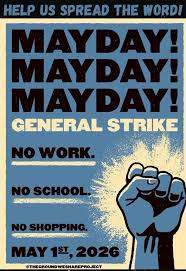
Every Labor Day, the origin story gets laundered. The first Monday of September was signed into law in 1894, in the same season the federal government was sending troops to crush the Pullman strike — a holiday handed down from above, deliberately months away from the workers' own day. Because May 1 belongs to us: to the general strike for the eight-hour day in 1886, to the anarchists the state framed and hanged for it, and to every movement since that learned the same lesson — which is why May Day 2026 became a global uprising of workers over billionaires. The respectable holiday was a concession. The workers' holiday is a threat.
What happened this September is what that threat looks like when it's practiced, not performed. Guards voting to stop guarding the offices of the men building artificial general intelligence. Miners stopping the only American source of a strategic metal. Casino workers making a billion-dollar resort feel what a missing housekeeper costs. A hundred thousand clerks and nurses preparing to switch off a state. Nobody begged for it, nobody bought it, and no politician is going to deliver it — that's the whole point of a strike. The power was always in the hands doing the work. The wave that started this year isn't cresting. It's just getting organized.
May Day's history tells you where this road leads.
Sources & Methodology(20 sources)
Sept 2, 2026: SEIU-USWW security officers vote to authorize a ULP strike; Huerta demands $30 minimum wage and benefits; Tejinder Singh (Google security officer) on bargaining; Allied Universal declines comment.
- Bay City News via Local News Matters — SF Security Guards for Big Tech Authorize Strike, Demand Living WageNews Article
Sept 4, 2026: ~80 guards and reps rally in the rain at Battery and Market Sts; contractors Securitas, Allied Universal, PalAmerican; complaints of low pay, inadequate training, understaffing, lack of family health coverage.
Sept 2026: SEIU-USWW strike authorization covers guards at major AI offices; contractor bargaining context.
Syndicated wire summary: SEIU-USWW represents roughly 14,000 security workers; bargaining with Allied, Securitas, GardaWorld over Bay Area wages and benefits.
- United Steelworkers — USW Announces Unfair Labor Practice Strike Against Sibanye StillwaterStatement
USW press release: ~420 members of Local 11-0001 at the Nye Mine and Columbus Metallurgical Complex begin a ULP strike after rejecting three contract proposals.
Detailed contract terms: family deductible $500 to $1,000 (2027)/$1,200 (2028)/$1,400 (2029); disability cut from 180 days at 100% to 80%/67% tiers; incentive-structure injury-reporting concerns; company claims $30M annual health spend and 5% wage offer; four mine fatalities in four years; Cameron and McDowell quotes.
Sept 4, 2026: ~40% of workforce on strike; Beluscak, Benner, Goff quotes; picket rotation at Columbus union hall and Nye mine; ITC ruling and Russia-competition context; photo of picketer Aven Benner.
Company release (Johannesburg, Sept 2, 2026): union notice of intent to strike 7am MT Sept 3 at Stillwater East and Columbus metallurgical facility after 4+ months of negotiations.
Market data: palladium closed 4.9% higher at $1,441/oz on Sept 3, 2026, as 420 steelworkers struck the only primary palladium mine and PGM refinery in the US.
July 22, 2026 GAO study (requested by Sen. Sanders): Amazon workers on SNAP/Medicaid nearly tripled since 2020; 11 states examined; Walmart top employer of benefits recipients in all states; gig companies newly among top employers.
CNN wire: GAO figures (12,350 SNAP / 11,350 Medicaid Amazon workers); 2024 Census data (14M working adults on Medicaid, 10.6M SNAP households); Sanders statement; Amazon (Rachael Lighty) response; OBBBA work requirements timeline; NJ employer assessment.
- The Washington Post — Amazon, Gig Companies See Spike in Workers on SNAP and Medicaid, Study ShowsNews Article
July 22, 2026: Amazon workers on federal aid nearly tripled 2020–2025; ride-hailing and delivery drivers newly on GAO lists.
Labor Day 2026: ~100,000 California state workers to vote on ULP strike authorization; bad-faith bargaining with Newsom administration; telework, pay, health care demands; never struck statewide; PERB charge filed July 22; Anica Walls statement; CalHR response.
- The Boston Globe — 'We're Here to Win.' Roughly 1,300 Workers at Encore Boston Harbor Launch StrikeNews Article
Sept 4, 2026: UNITE HERE Local 26 and Teamsters Local 25 strike after contracts expire; picket-line photos and worker interviews; negotiation history since April.
~1,350 workers (41% of workforce) strike through Labor Day weekend; Woodard, Green, Atkins quotes; ~$700M gaming revenue cited; Wynn statement on wage/benefit growth and $95K average comp.
Thousands of Washington state workers walked off at 125 job sites for one hour Monday (Sept 1 story) ahead of contract deadline, demanding wage increases.
Sept 7, 2026: thousands march in Wilmington ILWU parade; Jesse Munoz on 2,000+ jobs lost to automation; union density +463,000 to 10.0% in 2025 with private sector flat at 5.9%; midterm politics at Labor Day events.
Sept 1, 2026: Micron Taiwan unions move toward possible strike action over bonus system and profit-sharing.
Sept 2, 2026: unions demand overhaul of bonus system and greater profit sharing amid AI memory boom.
Sept 9, 2026: POSCO union begins 48-hour partial strike — first stoppage since the steelmaker's 1968 founding — after wage talks collapsed; NLRC mediation ended without agreement.
Methodology
Reporting synthesized from: KQED and Bay City News/Local News Matters on the SEIU-USWW strike authorization (Sept 2–4, 2026); the USW press release, Montana Free Press, Yellowstone Public Radio, and company statements via IRW-Press on the Sibanye-Stillwater ULP strike (Sept 2–4); the GAO report (GAO-26-108703, released July 22, 2026) with CNN and Washington Post coverage for SNAP/Medicaid data; Boston Globe and WCVB on the Encore Boston Harbor strike; KCRA/Fox40 on the SEIU Local 1000 strike vote announcement; the Los Angeles Times (via Spokesman-Review syndication) on Wilmington Labor Day events; Reuters/Taipei Times on Micron Taiwan; Seoul Economic Daily and UPI on the POSCO strike. All worker quotes verified against published interviews; company positions included for right of reply. Market data (palladium +4.9% to $1,441/oz on Sept 3) from exchange reporting. Images carry credited provenance: SEIU-USWW via Bay City News; Yellowstone Public Radio; David L. Ryan/The Boston Globe; Los Angeles Times.
Filed Under
Frequently Asked Questions
- What is an unfair labor practice (ULP) strike?
- A ULP strike is a work stoppage protesting an employer's violation of labor law — such as bad-faith bargaining — rather than a purely economic strike over wages. Both SEIU-USWW security officers in the Bay Area and SEIU Local 1000 in California voted or are voting to authorize ULP strikes, which under federal and state labor law give workers stronger reinstatement protections.
- Why did Big Tech security guards vote to authorize a strike?
- On September 2, 2026, security officers across San Francisco and Silicon Valley, organized with SEIU-United Service Workers West, voted to authorize a ULP strike after months of failed negotiations with contractors including Allied Universal, Securitas, GardaWorld, and PalAmerican. The guards — who stand watch at offices including Google, OpenAI, and Anthropic — are demanding a $30 minimum wage and better benefits; union president David Huerta noted many earn about $22 an hour in San Francisco.
- Why did Montana miners strike Sibanye-Stillwater?
- About 420 members of United Steelworkers Local 11-0001 struck the Nye Mine and Columbus metallurgical complex on September 3, 2026, after rejecting three contract offers. The proposal would raise the family health deductible from $500 to as much as $1,400, cut short-term disability pay, and — workers say — create incentive pay that discourages reporting injuries and environmental spills. The company says palladium prices force concessions and offered a 5% wage increase.
- What did the GAO report find about Amazon workers on SNAP and Medicaid?
- The July 2026 GAO report, requested by Sen. Bernie Sanders, found the number of Amazon employees on food stamps and Medicaid nearly tripled between 2020 and 2025 — 12,346 Amazon workers on SNAP and 11,338 on Medicaid across 11 states studied. Walmart was the top employer of workers on public assistance in every state examined, and rideshare and delivery companies appeared among top employers for the first time — as Amazon planned roughly $200 billion in AI spending for 2026.
- How big is the current strike wave?
- The first week of September 2026 alone saw a strike authorization by roughly 14,000-represented Bay Area security workers, a live strike by 420 Montana miners, about 1,350 casino workers striking Encore Boston Harbor through Labor Day weekend, a one-hour walkout at 125 Washington state worksites, and a strike vote announcement by roughly 100,000 California state employees — with POSCO's first strike in 58 years in South Korea and a near-strike vote at Micron Taiwan. US union density ticked up to 10.0% in 2025, driven by public-sector organizing.