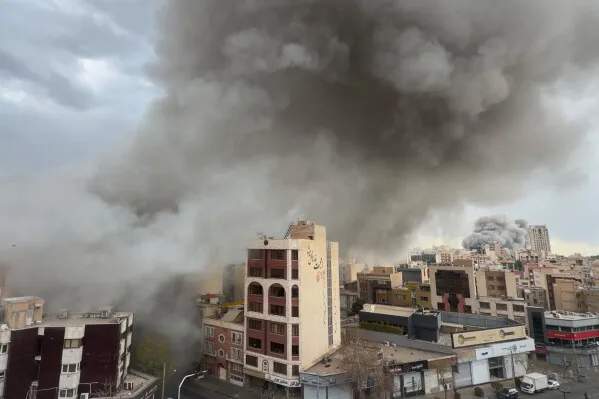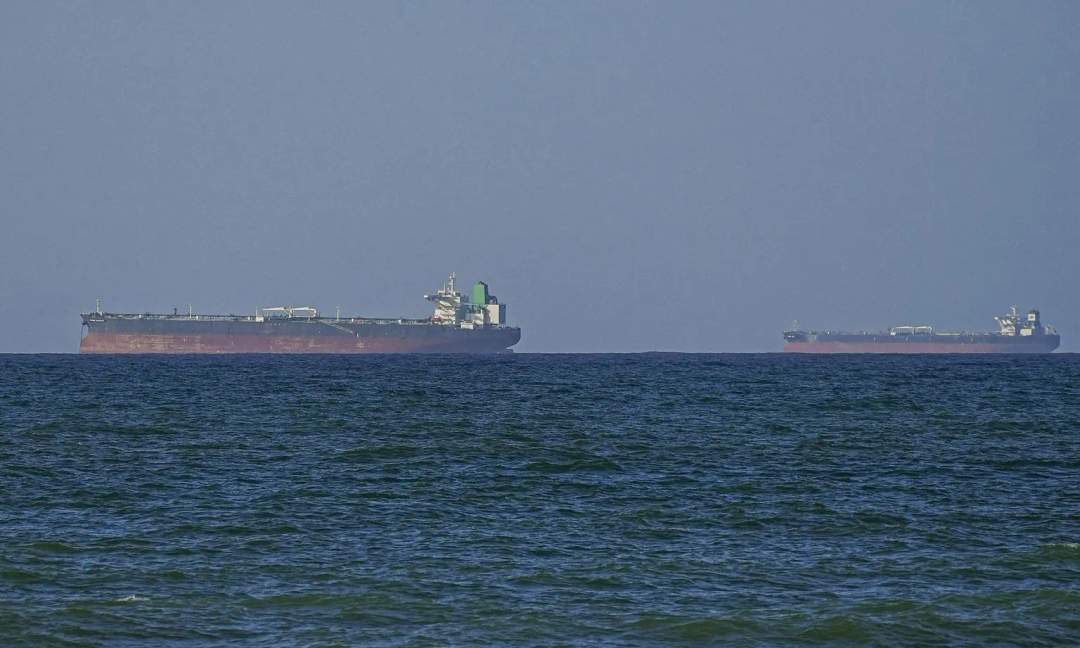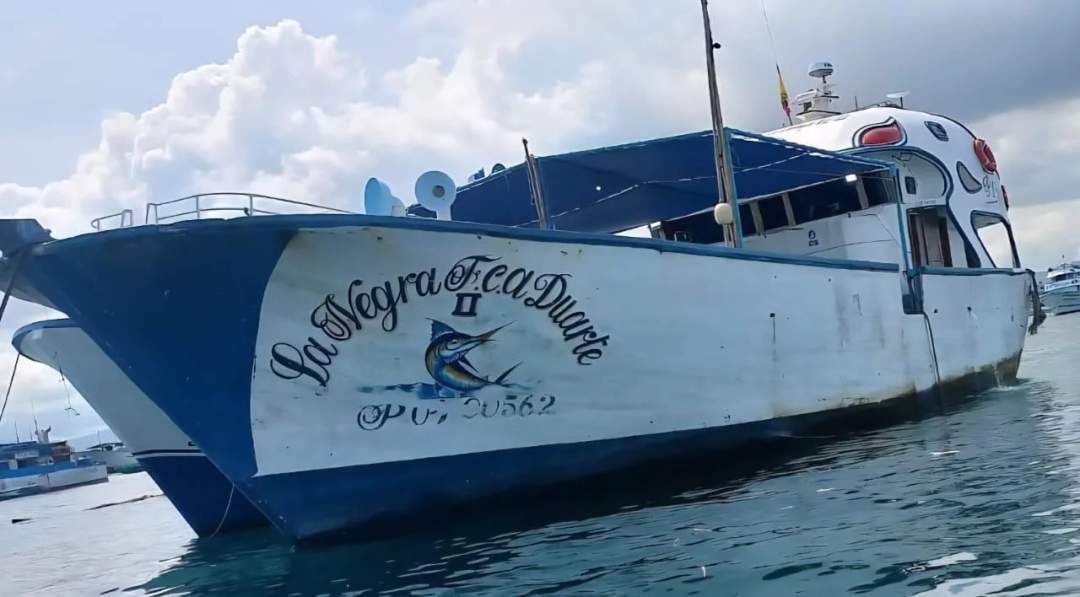

On July 20, 2026, Yemen's Ansarallah movement — known internationally as the Houthis — declared a formal maritime embargo on Saudi Arabia, closing the Bab al-Mandeb Strait to all vessels loading or discharging cargo at Saudi ports. Within hours, at least four oil tankers carrying a combined 3.8 million barrels of crude made U-turns in the Red Sea, reversing course before reaching the narrow waterway that connects one of the world's busiest shipping lanes to the Gulf of Aden. By the end of the week, Ansarallah forces had struck the Saudi-flagged tankers Encelia and Layla with missiles and drones. Fire broke out on the Encelia's bow. Days later, a third tanker, the NCC Ghazal, was hit with ballistic missiles. On August 5, Ansarallah announced it was expanding operations into the northern Red Sea, claiming a strike on the NCC Wafa off the port of Yanbu.
Saudi Arabia, which had been using the 1,200-kilometer East-West Pipeline to reroute millions of barrels per day around the now-closed Strait of Hormuz, watched its last functional maritime export route wither. Brent crude hit $100 a barrel. The 18-mile-wide Bab al-Mandeb — through which roughly 7% of global oil transits — had become a kill zone.
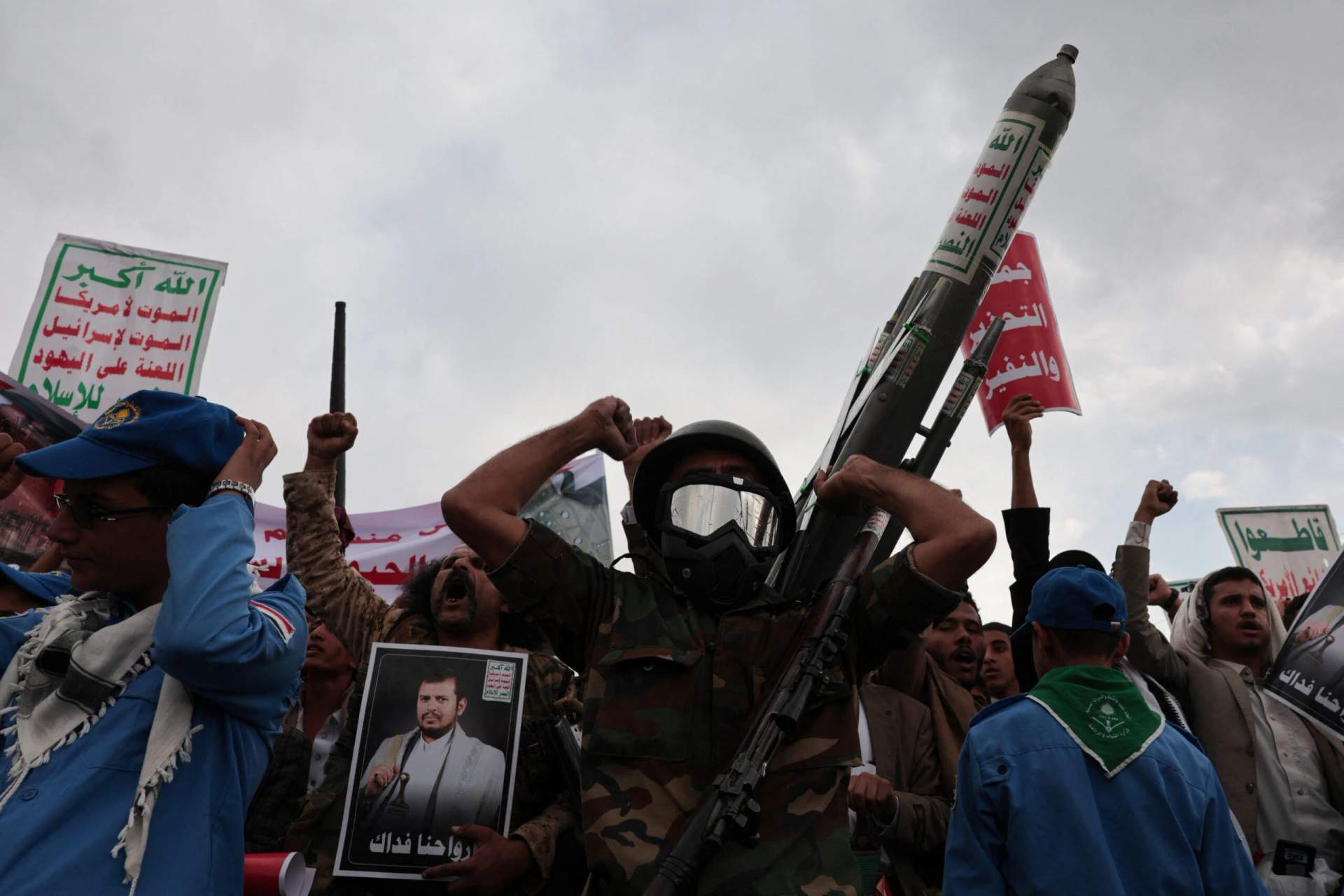
Large crowd of Houthi supporters gathered at a nighttime rally in Sanaa, Yemen, with floodlights and a stage visible, many holding flags and placards
The Blockade Behind the Blockade
Every Western headline about Ansarallah's Red Sea operations carries the same formula: "Iran-backed Houthis" — a prefix that functions as a thought-terminator. It reduces a movement of hundreds of thousands of Yemeni fighters who control the capital, govern most of the country's populated territory, and have survived nearly twelve years of aerial bombardment to the status of remote-controlled puppets.
The reality is more uncomfortable for Washington and Riyadh. Ansarallah seized Sanaa in 2014 during Yemen's political upheaval, not as an Iranian proxy operation but as an indigenous Zaidi movement capitalizing on a vacuum created by a failed state. Saudi Arabia responded in 2015 by assembling a Western-armed coalition that dropped bombs on Yemen for seven years, killed an estimated 377,000 people by indirect causes — starvation, disease, collapsed healthcare — and imposed a comprehensive land, sea, and air blockade on Ansarallah-controlled territory that remains in effect today.
That blockade is the originating sin. Yemen's ports have been choked. Its airports restricted. Its fuel supplies rationed by a Saudi-led coalition that Ansarallah spokespersons describe as "an unjust and oppressive siege" lasting "nearly 12 years." Twenty-two million Yemenis — roughly two-thirds of the population — currently need humanitarian assistance. Eighteen million face acute food insecurity. This is not ancient history. It is the present condition that Ansarallah says drove its declaration: "an eye for an eye," as the group's July 20 statement put it. "A blockade for a blockade."
The group's military spokesman, Brigadier General Yahya Saree, framed the embargo as a direct response to the July 13 bombing of Sanaa International Airport's runway — an attack carried out by Yemen's internationally recognized government, which Ansarallah blamed on Riyadh. Days before, Ansarallah had fired ballistic missiles at Saudi Arabia's Abha International Airport in retaliation. The ceasefire that had held since 2022 — fragile, barely a ceasefire at all — was over.
The Two Chokepoints: How One War Choked the World
The Ansarallah embargo did not emerge from a vacuum. It detonated inside an already burning regional conflagration — the US-Israel war on Iran, which had effectively closed the Strait of Hormuz since late February 2026.
The Strait of Hormuz, through which 25% of the world's oil and gas supplies pass, had become a mined, contested waterway. Iranian forces attacked a dozen tankers near Oman and the UAE between July 6 and July 20, killing two seafarers and injuring more than a dozen. The International Maritime Organization documented the casualties. Iran declared the strait "completely closed."
Saudi Arabia, with its primary Persian Gulf export route severed, turned to the East-West Pipeline — the 1,201-kilometer conduit running from the Abqaiq oil fields across the entire kingdom to the Red Sea terminal at Yanbu. Shipments from Yanbu through Bab al-Mandeb surged from 240,000 barrels per day in the same period last year to 3.5 million barrels per day in June, according to Kpler data cited by CNBC. Total petroleum volumes transiting Bab al-Mandeb hit 7.4 million barrels per day — about 7% of global oil output.
When Ansarallah closed the Bab al-Mandeb, it did not just threaten Saudi oil. It threatened the entire workaround that the global energy system had built to survive the Hormuz closure. The two chokepoints — Hormuz in the east and Bab al-Mandeb in the west — together account for roughly a quarter of all oil and gas shipments on Earth. Both were now closed or functionally closed within months of each other.
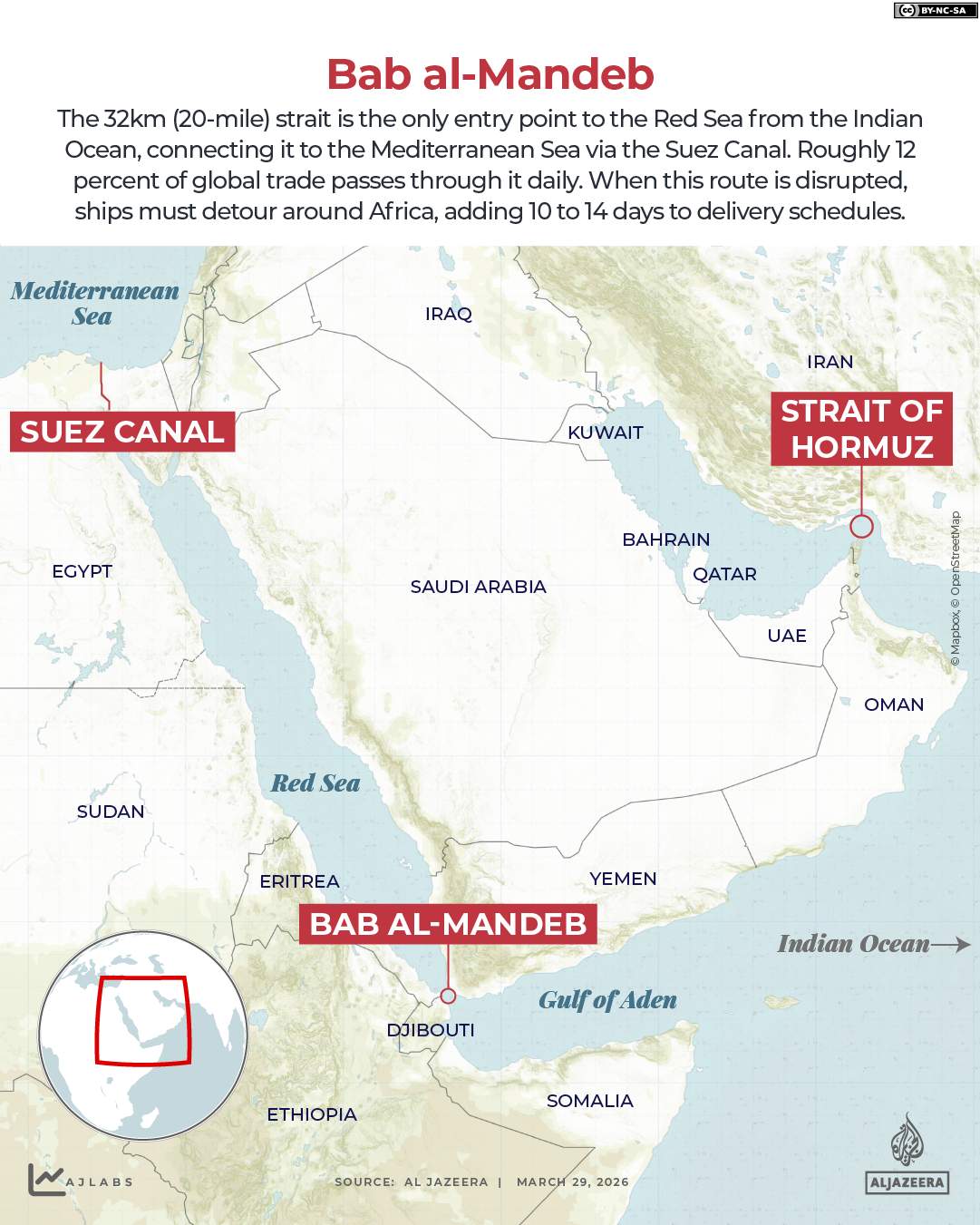
Satellite map of the Bab al-Mandeb Strait showing shipping routes through the narrow waterway between the Arabian Peninsula and the Horn of Africa
Ships That Won't Move: The Economics of Fear
The maritime data tells its own story. Ship-tracking firm Kpler observed a 34% decline in traffic through the Bab al-Mandeb on July 21, the day after Ansarallah announced the embargo. Windward, a maritime intelligence firm, confirmed that four tankers carrying Saudi cargo — 3.8 million barrels of crude oil, gasoil, and naphtha — turned around before reaching the strait. Saree claimed six ships had reversed course; Lloyd's List counted seven.
The Joint Maritime Information Center, a Bahrain-based naval security group, initially rated the threat "moderate" and noted that commercial traffic continued through established lanes. But the JMIC also confirmed that Ansarallah had "completed preparations to attack shipping, including the deployment of missiles and drones positioned near Bab el-Mandeb." The European Union's naval mission in the Middle East was less restrained, advising merchant vessels "linked to Israeli, U.S. or Saudi interests" to "avoid transiting the Red Sea and Gulf of Aden until the threat level decreases."
Brent crude spiked above $100 a barrel — a level not seen since the early days of the Iran war in March. By July 27, prices had briefly fallen below $88 after the US paused strikes on Iran, but the underlying fragility was unmistakable. Two of the world's most important maritime chokepoints were in play simultaneously, and neither showed signs of reopening soon.
For Saudi Arabia, the math was brutal. The kingdom's oil revenues — the foundation of Vision 2030, Mohammed bin Salman's economic transformation project — were caught between a strait closed by Iran and a strait now closed by Yemeni fighters with a fraction of Saudi Arabia's military budget. The weapons disparity that once seemed to guarantee Saudi dominance had produced the opposite: a decade of bombing had not broken Ansarallah, and now Ansarallah was imposing costs that Riyadh's multibillion-dollar air defense systems could not prevent.
The Escalation Ladder: Saudi Strikes and American Threats
On July 25, Saudi Arabia responded. Coalition forces struck Houthi military targets in Yemen, with Major General Turki Al-Malki, spokesperson for the Saudi-led coalition, stating the strikes "focused solely on legitimate military targets that the terrorist Houthi militia uses to threaten commercial vessels in the Red Sea." Air defenses intercepted two ballistic missiles fired from Yemen toward oil refineries in Yanbu. Greek-operated defense systems handled the interception, Reuters reported.
Saudi Civil Defence issued warnings for Yanbu before declaring the danger had passed. No damage was immediately reported. But the message was clear: the 2022 truce was finished, and Saudi Arabia was willing to strike Ansarallah positions to protect its oil exports.
Then Washington spoke. Donald Trump, in a post on Truth Social, warned that any further Houthi attacks would result in "major military punishment" inflicted upon "Iran and, of course, the Houthis, themselves." He called the group a "Surrogate and/or Proxy of Iran." Secretary of State Marco Rubio added that the Houthis had "apparently gotten themselves suckered into this" by Tehran.
The framing was automatic and revealing. Ansarallah's statement of July 20 had said nothing about Iran. It spoke of Saudi blockades, Sanaa airport, twelve years of siege. The group's calculus was explicitly Yemeni — retaliation for a specific attack, leverage in a specific conflict with a specific neighbor. But Washington's response stripped Ansarallah of all agency, reducing a sophisticated military and political movement to a cat's-paw for Tehran. The erasure serves a purpose: it makes the conflict legible within the US-Iran framing that dominates Washington's regional thinking, and it avoids confronting the inconvenient fact that Ansarallah has its own reasons — deeply Yemeni reasons — for going to war with Saudi Arabia.
UN envoy Hans Grundberg, who is actually required to understand Yemen's internal dynamics, saw it differently. He warned on July 24 that the resumption of Red Sea attacks risked "dragging the country back into full-scale war" and "deepening the suffering of the Yemeni people." He called for negotiations. Twenty-two million people need aid this year. Eighteen million don't have enough to eat. The country has been at war since 2015. The clock is not ticking toward a solution — it's ticking toward another catastrophic escalation.
The Northern Expansion: No Exit Through Suez
If the Bab al-Mandeb closure forced tankers south, the next move was designed to close the northern escape hatch.
On August 5, Saree announced that Ansarallah had struck the Saudi oil tanker NCC Wafa in the northern Red Sea off Yanbu with "a number of ballistic missiles" — a "precise hit." The statement declared that the group was "tightening the naval blockade on the Saudi enemy at Bab al-Mandeb" and would "continue and escalate in targeting Saudi oil vessels in the northern Red Sea, to close off every route and prevent passage, in order to cement the 'blockade for blockade' equation."
The logic was tactical. With Bab al-Mandeb too dangerous for southern transit, some Saudi vessels had begun routing north through the Suez Canal instead — a longer, more expensive path, but one that avoided Ansarallah-controlled waters. By extending operations into the northern Red Sea, Ansarallah was attempting to make that alternative equally untenable.
If successful, it would leave Saudi Arabia with almost no maritime export route. The East-West Pipeline delivers oil to Yanbu. From Yanbu, tankers must go south through Bab al-Mandeb or north through the Suez Canal. Both routes would be under Ansarallah fire. The only remaining option — rerouting around the entire African continent via the Cape of Good Hope — would add weeks and enormous cost to every shipment.
The implications extend beyond Saudi Arabia. Egypt's Suez Canal revenues — a critical source of national income — would face direct threat if Ansarallah begins operating in the canal's southern approaches. European energy supplies, already strained by the Hormuz closure, would face another bottleneck. The US Navy, already stretched thin conducting consecutive nightly strikes on Iran and maintaining a presence in the Persian Gulf, would face pressure to open a third front.
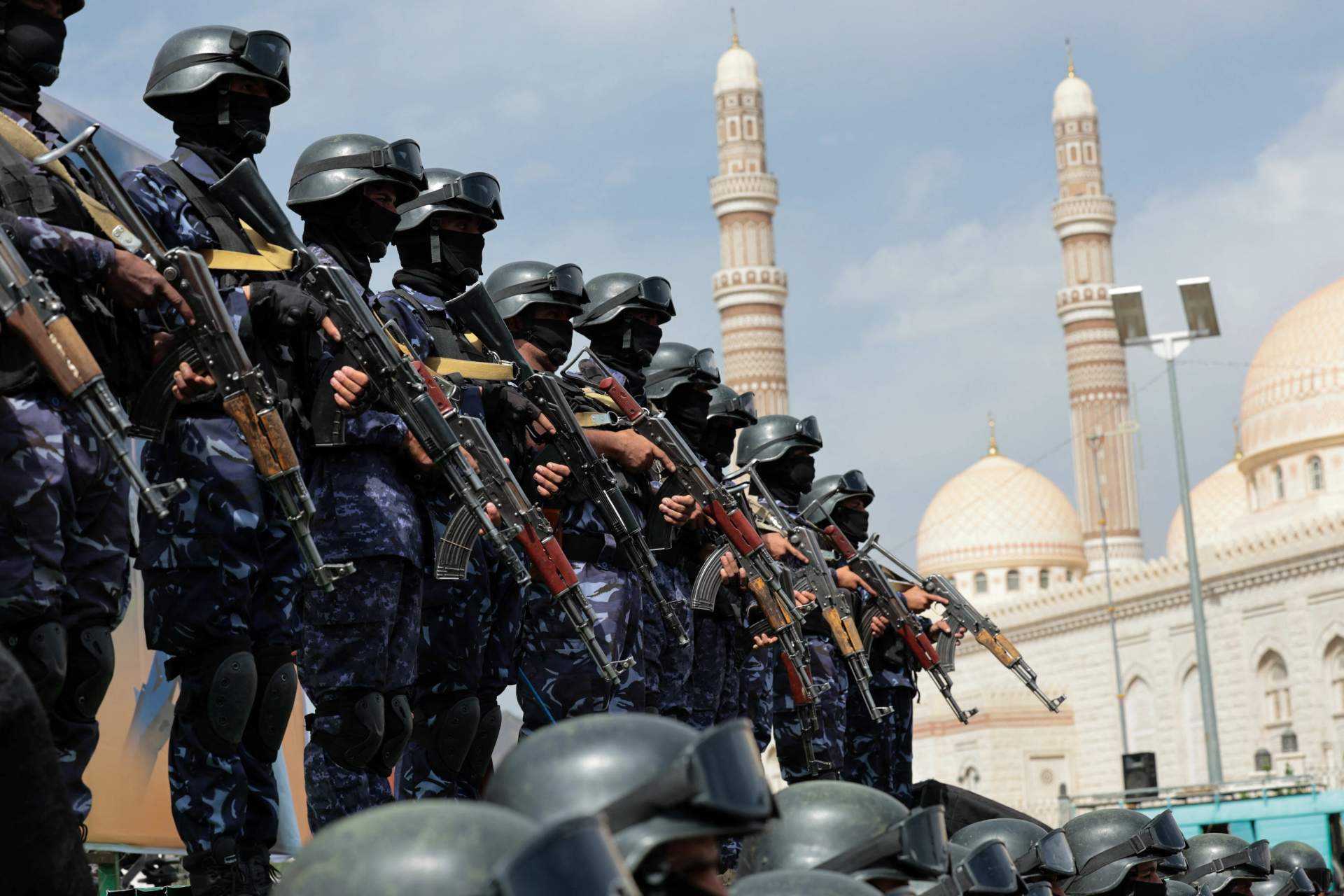
Houthi security personnel in uniform standing in formation at a rally in Sanaa, Yemen, with a crowd visible in the background
Who Bleeds When the Straits Close
The discourse around maritime chokepoints tends to abstract the human cost into shipping data and barrel counts. But the people at the bottom of this cascade are not abstract.
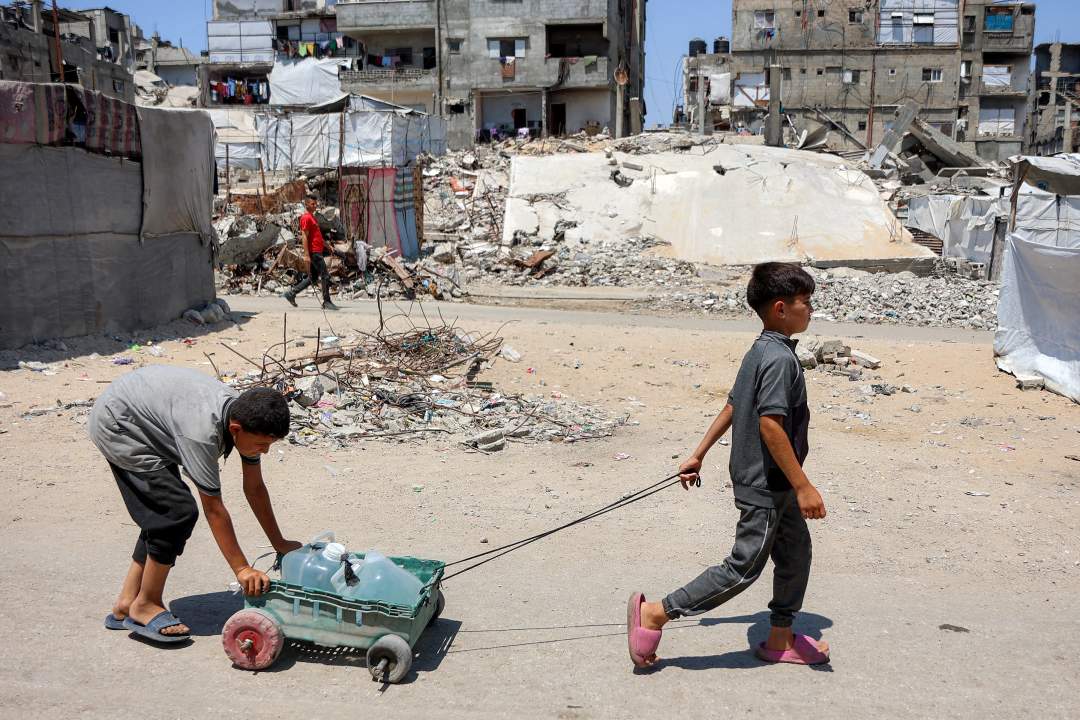
In Yemen, 22 million people — a population larger than Florida — depend on humanitarian aid that arrives through ports under blockade. The Saudi-led coalition's restrictions on Hodeidah, Ansarallah's main port city, have for years limited the flow of food, fuel, and medicine into a country where cholera has infected over a million people. Every escalation between Riyadh and Sanaa risks further constraining those supply lines. Grundberg's warning about "deepening the suffering" was not diplomatic boilerplate; it was a description of what happens when aid ships can't dock.
In the Strait of Hormuz, two seafarers have already been killed and more than a dozen injured in Iranian attacks on commercial vessels since July 6. These are civilian workers — Indian, Filipino, Pakistani, Sri Lankan sailors manning tankers that carry the world's fuel. They have no stake in the US-Iran war, no investment in Saudi-Iranian rivalry. They are, as always, the invisible casualties of conflicts between powers that consider their lives operational noise.
In Saudi Arabia itself, the populations of Yanbu and Jizan — cities on the Red Sea coast now within range of ballistic missiles — live under air defense alerts and Civil Defence warnings. Greek-operated interceptor systems guard Saudi skies, a reminder that even the kingdom's own forces rely on foreign personnel for protection. The Saudi citizens of these cities did not choose this war. The 2015 intervention was a royal decision, not a popular one, and its consequences have come home.
The Propaganda Filter: Why You Only Hear "Iran-Backed"
There is a reason the Western press consistently prefixes Ansarallah with "Iran-backed" and rarely, if ever, describes the group by its official name or acknowledges its domestic political program. The prefix is not a descriptor — it is a framing device. It performs three functions simultaneously:
First, it externalizes the conflict. By attributing Ansarallah's actions to Iranian direction, it removes the need to engage with Yemeni grievances — the blockade, the bombing, the humanitarian catastrophe — that motivate the group's military operations. The story becomes about Iran's regional ambitions rather than Saudi Arabia's war on Yemen.
Second, it justifies escalation. If Ansarallah is merely an Iranian proxy, then any US military response against Yemeni targets becomes an extension of the "legitimate" US-Iran conflict rather than an expansion into a separate war. Trump's Truth Social threat — "major military punishment" on both Iran and the Houthis — assumes precisely this logic.
Third, it erases Ansarallah's political legitimacy within Yemen. The group governs Sanaa. It administers services, collects taxes, maintains a military of hundreds of thousands, and enjoys significant popular support in the territories it controls. It negotiated the 2022 truce directly with Saudi Arabia, demonstrating an independent diplomatic capacity that a mere proxy would not possess. Its Red Sea operations from 2023 to 2025 — conducted in solidarity with Gaza — earned it substantial goodwill across the Arab world, precisely because they were understood as a sovereign choice, not a Tehran command.
None of this means Iran and Ansarallah lack a relationship. They do. Iran has provided weapons, training, and political support. But the relationship is better understood as an alliance of convenience between two anti-Western, anti-Saudi forces with overlapping but distinct interests — not as a master-servant arrangement. Ansarallah's decision to blockade Saudi shipping was driven by the Sanaa airport bombing, the ongoing Saudi blockade of Yemeni ports, and the collapse of the 2022 truce. These are Yemeni grievances. Washington's refusal to acknowledge them is not an analytical error. It is a choice.
The Real Calculation: What Ansarallah Wants
Strip away the propaganda, and Ansarallah's maritime strategy is legible as a coherent bargaining position rooted in decades of conflict.
- Lift the blockade. The Saudi-led coalition's restrictions on Ansarallah-controlled ports and airports have caused civilian suffering on a massive scale. The maritime embargo is designed to impose reciprocal costs until Saudi Arabia feels the pain of its own policy.
- End the bombing. The July 13 attack on Sanaa airport's runway — conducted by Yemen's internationally recognized government with Saudi backing — was the proximate trigger. Ansarallah wants guarantees that its airspace and infrastructure will not be targeted.
- Negotiate from strength. The 2022 truce left the fundamental political questions unresolved. Ansarallah controls most of Yemen but is denied international recognition and subjected to economic strangulation. The maritime campaign demonstrates that the group can impose costs that the Saudi-led coalition cannot easily absorb — leverage for any future negotiation.
Whether this strategy succeeds or merely accelerates Yemen's slide back into full-scale war depends on variables no one fully controls: Saudi Arabia's willingness to absorb economic damage versus its willingness to negotiate, Washington's appetite for another military commitment in the Middle East, and Ansarallah's ability to sustain operations against a technologically superior adversary.
What is clear is that the model of using Western military superiority to force Ansarallah to capitulate — the model that guided Saudi strategy from 2015 to 2022 — has failed. Seven years of bombing did not break the movement. The blockade did not starve it into submission. And now the movement is imposing costs on the very power that sought to subjugate it.
A War the World Cannot Afford to Ignore
The convergence of the Hormuz and Bab al-Mandeb closures represents something the world has not faced since the 1973 oil crisis: the simultaneous disruption of two of the three most critical maritime chokepoints for global energy. Twenty-five percent of oil and gas shipments pass through Hormuz and Bab al-Mandeb combined. Both are now closed or functionally closed. Oil is above $100 a barrel. Shipping companies are rerouting vessels around Africa at enormous cost.
And yet the dominant framing in Western media remains fixated on Iranian malice and Houthi provocation — a framework that treats the choking of global shipping lanes as inexplicable aggression rather than the predictable consequence of years of blockade, bombardment, and diplomatic failure.
Ansarallah did not create this crisis alone. Saudi Arabia's decade-long war on Yemen created the conditions. The US-backed Saudi coalition created the blockade that Ansarallah says it is responding to. The US-Israel war on Iran created the regional environment in which one closure cascaded into another. The chain of causation is visible to anyone willing to look.
The question is not whether the Red Sea blockade is dangerous — it is. The question is whether the world is willing to confront the full chain of responsibility that produced it, or whether it will continue to accept the convenient fiction that the only actors who matter are in Tehran, while the bombs that fell on Yemen for seven years and the blockade that continues to strangle 22 million people remain invisible.
Sources & Methodology
Methodology
Reporting based on cross-referenced wire service reports (Reuters, AP, AFP) published via BBC, CNBC, Al Jazeera, The Guardian, and The War Zone between July 20 and August 6, 2026. Maritime data from Kpler, Windward, and the Joint Maritime Information Center (JMIC). Oil price data from multiple financial outlets. UN humanitarian figures from UNHCR and UN envoy Hans Grundberg's public statements. All claims verified against at least two independent sources.
Filed Under
Frequently Asked Questions
- What did Ansarallah announce on July 20, 2026?
- Ansarallah declared a formal maritime embargo on Saudi Arabia, closing the Bab al-Mandeb Strait to all vessels loading or discharging cargo at Saudi ports. The group said the embargo was in retaliation for a Saudi-led blockade on Ansarallah-controlled ports and airports in Yemen, and specifically for a July 13 bombing of Sanaa International Airport's runway.
- Which ships have been attacked since the blockade declaration?
- Ansarallah forces have struck at least four Saudi-linked oil tankers: the Encelia (fire on the bow, confirmed by Saudi authorities), the Layla, the NCC Ghazal (ballistic missiles), and the NCC Wafa (claimed strike off Yanbu in the northern Red Sea on August 5). Multiple other tankers reversed course to avoid the strait.
- Why does this matter for global oil supplies?
- The Strait of Hormuz — through which 25% of the world's oil and gas passes — was already effectively closed due to the US-Israel war on Iran. Saudi Arabia had been rerouting oil through its East-West Pipeline to the Red Sea terminal at Yanbu. The Ansarallah embargo closed that alternative route at Bab al-Mandeb. Combined, the two closures affect roughly a quarter of global energy shipments.
- What is Ansarallah's stated goal?
- Ansarallah says it is imposing a 'blockade for a blockade' — retaliating against Saudi Arabia's years-long land, sea, and air blockade on Ansarallah-controlled territory in Yemen. The group wants the Saudi blockade lifted, an end to bombings of Yemeni infrastructure, and leverage for future negotiations over Yemen's political future.
- Who are the Houthis/Ansarallah?
- Ansarallah — commonly called the Houthis after their founding leader Hussein Badreddin al-Houthi — is a Zaidi political and military movement that seized Yemen's capital Sanaa in 2014. They control most of Yemen's populated territory and have survived nearly 12 years of war against a Saudi-led, Western-armed coalition. They are allied with Iran but operate with significant autonomous political and military agency.