
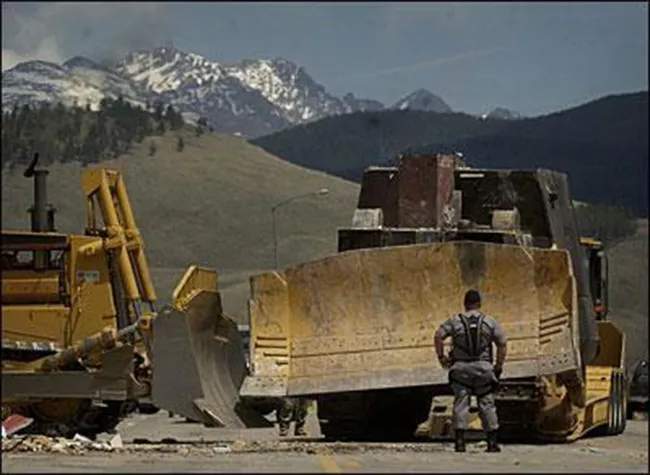
Twenty-two years ago today, on June 4, 2004, a 52-year-old welder named Marvin Heemeyer sealed himself inside a modified Komatsu D355A bulldozer — an 85-ton machine he had spent a year and a half secretly converting into an armored tank — and drove it through the town of Granby, Colorado.
He demolished 13 buildings. The Granby town hall. The former mayor's house. A concrete plant. A hardware store. He fired a .50 BMG rifle from gun ports cut into his steel-and-concrete armor. He caused more than $5 million in damage.
No one was killed. No one was injured — except Marvin Heemeyer himself, who took his own life inside the cab when the treads of his machine finally bogged down in the rubble of Gambles Hardware on Highway 40.
The media called it the "Killdozer rampage." The documentary Tread (2020) framed it as the act of a man who "snapped." Former SWAT commander Grant Whitus called him a monster: "His intent was certainly to maim and kill." Comment sections across the internet called him a hero.
But the real story of Marvin Heemeyer isn't about whether he was a hero or a madman. It's about the machinery — not the bulldozer, but the system — that ground him down over 12 years and left him with no institutional avenue left to stand on.
A Working-Class Man in a Town Run for Developers
Heemeyer wasn't born to radicalism. He was born on a dairy farm in Castlewood, South Dakota in 1951. He moved to Colorado in 1974 after a stint at Lowry Air Force Base. He ran muffler shops around Denver. Friends described him as affable. His brother Ken said he "would bend over backwards for anyone."
In 1992, Heemeyer bought two acres of land in Granby at auction for $42,000. He planned to lease it to a friend for an auto repair shop. It was, by all accounts, a modest investment by a working man trying to build something.
Then the Docheff family came into the picture. The Docheffs — who had previously owned the land Heemeyer bought — wanted to expand their Mountain Park Concrete business and began buying up surrounding parcels. The town planning commission told them they needed Heemeyer's plot to keep the plant away from the main road.
So began a multi-year pressure campaign. The Docheffs offered Heemeyer $250,000 for land he'd bought for $42,000. He asked for $375,000. They scraped together $350,000. Heemeyer, by his own account, had the property reappraised and asked for $450,000. Whether you see this as greed or a man who knew his leverage, the negotiations broke down.
The town sided with the Docheffs. The concrete plant was approved. Heemeyer's access road was affected. His muffler shop — the small business he'd built — was suddenly dwarfed by an industrial concrete batching operation he had fought publicly to stop.
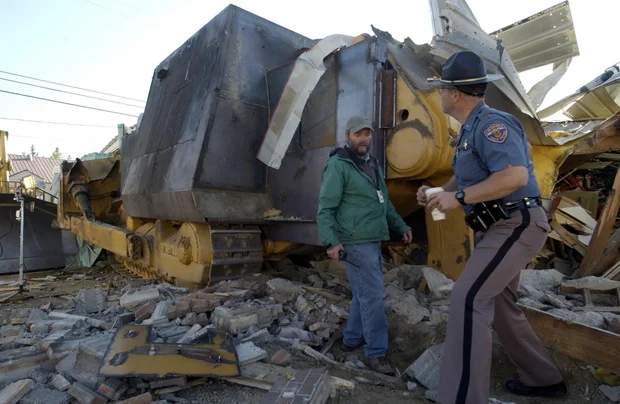
Colorado State Patrol Captain Gary Torgerson and Grand County Emergency Manager James Holahan examine the armored bulldozer in Granby Colorado June 5 2004
When Every Door Closes
Here is where the story stops being a property dispute and starts being a case study in how the American system discards people it finds inconvenient.
Heemeyer filed a lawsuit. Dismissed in April 2002. He appealed. Denied. He complained to the EPA. The Docheffs commissioned a noise study and were cleared. He went to the newspapers. They covered the concrete plant's side of the story.
Meanwhile, the town began enforcing codes against him. Heemeyer had operated for nearly a decade without a proper septic tank — the property had a buried cement mixer serving as a sewage container left by the previous owners. The city fined him $2,500 for code violations. He wrote "Cowards" on the check.
There's a particular cruelty in watching a wealthy family get the full machinery of local government to assist their business expansion while a single working man is fined into oblivion for failing to install a septic tank on land the town itself had botched the infrastructure for. The message was clear: the system was not neutral. It served those with capital. Heemeyer had none of the right kind.
The Bulldozer as Last Resort
After the lawsuit was dismissed, Heemeyer did something that, in a just society, would never have been necessary. He traveled to California, bought a decommissioned Komatsu D355A bulldozer at auction for $16,000, and shipped it to Granby.
Over the next 18 months, behind a wall he erected inside his leased building, Heemeyer transformed the bulldozer into what he called "Marv's Komatsu Tank." He welded layers of steel and poured concrete between them. He cut gun ports. He mounted three rifles, including a .50 BMG. He installed video cameras with bulletproof polycarbonate shields and air nozzles to blow dust clear. He stockpiled enough food and water for a week.
He sold his property for $400,000 — ten times what he paid — to a waste disposal company. The new owners had water and sewer connected within a day. Read that again. The infrastructure issue that had been used as a weapon against Heemeyer for a decade was resolved in 24 hours for the next owner.
On the morning of June 4, 2004, Heemeyer sealed himself inside his machine. He recorded a manifesto on audiotape. He drove the bulldozer through the wall of his shop and into Granby.
What the Rampage Actually Was
Heemeyer did not target randomly. He drove to specific buildings associated with specific people and institutions he believed had wronged him: the town hall that approved the concrete plant, the former mayor's home, the Docheff family's concrete plant, the newspaper office, the Gambles store. He fired his rifles — but aimed above occupied spaces. Investigators found no evidence he intended to kill anyone. His handwritten list of 107 targets included politicians, judges, business owners, and even a Catholic church that had opposed his gambling legalization campaign.
Colorado Governor Bill Owens reportedly considered calling in the National Guard. Police fired more than 200 rounds at the bulldozer. Explosives were detonated against its hull. Nothing penetrated. Three external explosions. Over 200 bullets. The armor held.
After more than two hours, the bulldozer's radiator was damaged and the engine began to fail. The treads bogged down in the debris of the Gambles Hardware store. SWAT was closing in. Heemeyer took his own life.
The governor later ordered the bulldozer disassembled and its parts scattered to prevent it from becoming a shrine.
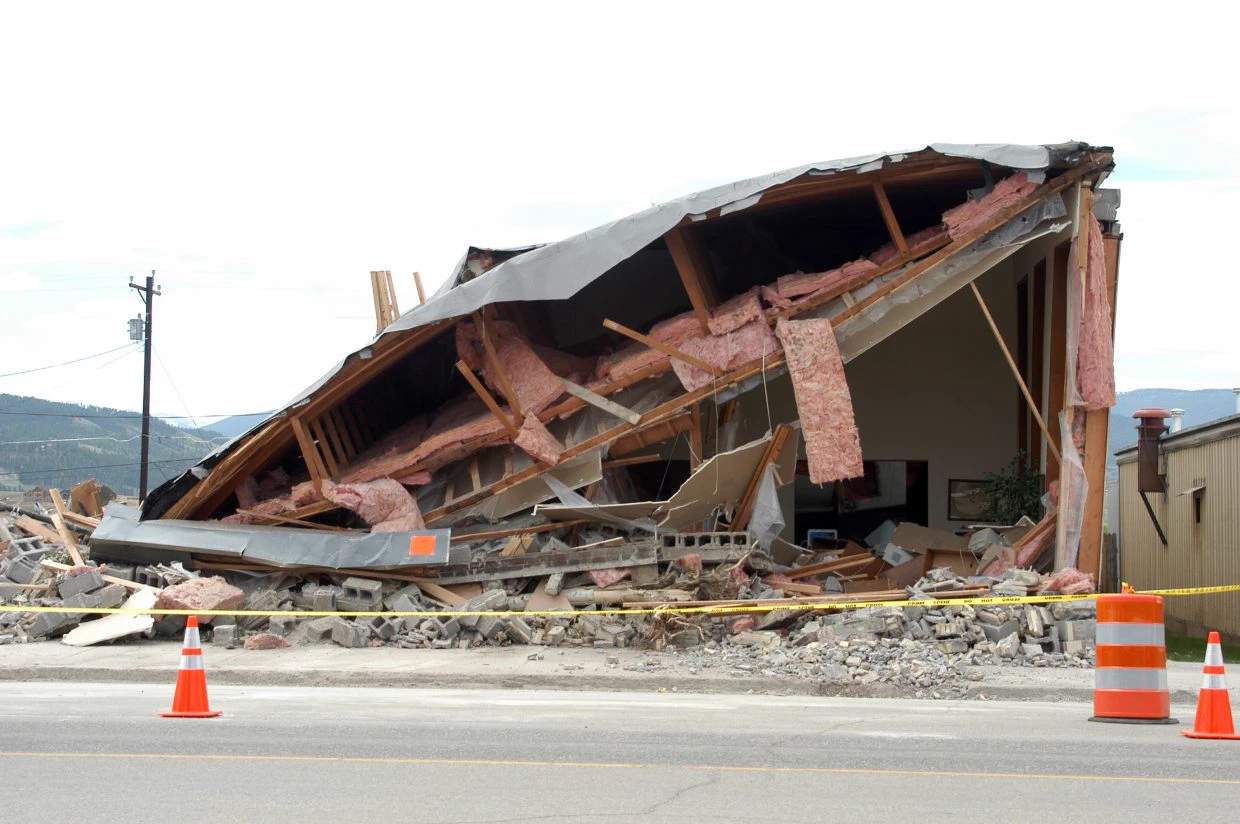
The destroyed Sky-Hi News newspaper office in Granby Colorado showing structural damage from the bulldozer rampage on June 4 2004
The System Worked — That Was the Problem
Here's what the mainstream coverage always misses, and what makes this story relevant 22 years later: the system didn't fail Marvin Heemeyer. The system worked exactly as designed. It worked for the Docheff family, who had capital, connections, and the weight of the planning commission behind them. It worked for the town officials who wanted tax revenue from a concrete plant. It worked for the new owners who got sewer connections installed in a single day.
It worked against Heemeyer precisely because he was a single working-class man with no institutional power, no wealth, and no allies left after his public campaign fizzled.
This is not an exoneration of what Heemeyer did. Targeting buildings with an armored vehicle — regardless of intent — is not justice. It is the violent collapse of a man who was denied justice by every legitimate channel available to him.
But that's the point.
Capitalism does not provide a dignified exit for people it steamrolls. It provides lawyers who lose your case. It provides fines you can't afford for problems you didn't create. It provides town councils that rubber-stamp the interests of capital while your small business suffocates under industrial dust. And when all those institutions fail you simultaneously, it provides nothing else.
There is no mechanism in the American system — legal, political, or economic — that asks: "What do we owe this man after a decade of being ground down?" There is only the assumption that if you couldn't win within the system, you deserved to lose.
A Pattern, Not an Anomaly
Heemeyer's story is extreme in its method. The conditions that produced it are not. We've documented this pattern over and over at UnTelevised.
In "The Fires Are Not Random — America Is Boiling Over", we traced how working-class rage erupts when the system leaves no peaceful outlet. That article documented warehouse fires, arson at Amazon facilities, and attacks on corporate infrastructure — all expressions of a population that has been abandoned by every institution that claims to serve them.
In ""Should Have Paid Us More": A Warehouse Fire and the Breaking Point of American Labor", we covered a Kimberly-Clark warehouse that burned to the ground after workers were pushed past their limit — the same dynamic: workers with grievances ignored until the grievance became a fire.
In "Nine Fires in Seven Days: The Working Class Has Handed Down Its Verdict", we showed how concentrated outbreaks of destruction are not random acts of chaos but deliberate verdicts from people the system has stopped listening to.
In "Fire at Raytheon Building in Georgia: When War Profiteers Meet Resistance", the target shifted from local government to the war machine itself — direct action against institutions that profit from death.
In "Cop City and the Feedback Loop of Empire: How War Comes Home", we documented how militarized policing in Atlanta — the same kind of state force that fired 200 rounds at Heemeyer's bulldozer — is the domestic arm of an empire that exports violence abroad.
In "$18.3 Trillion and Counting: How Billionaire Wealth Reaches Record Heights While the World Starves", the economic context becomes clear: wealth concentration at the top is not incidental to these outbreaks. It is the engine. Every warehouse fire, every bulldozer rampage, every Molotov cocktail thrown at a Raytheon office is connected to a system where the Docheff families of the world get their concrete plants approved and the Marvin Heemeyers get fined for their sewage.
The Killdozer as American Parable
The internet loves to debate whether Marvin Heemeyer was a hero. That's the wrong question. He wasn't a hero. He was a warning.
Every day in America, people are crushed by zoning boards, by developer deals cut in back rooms, by regulatory systems that punish the poor while clearing the path for the wealthy. Most of them don't build armored bulldozers. Most of them just... disappear. Quietly. One eviction notice, one code violation, one denied appeal at a time.
Heemeyer's violence was the exception. The conditions that produced it are the rule. And until those conditions change — until the system stops serving capital at the expense of human dignity — there will be more Marvin Heemeyers. The question isn't whether someone will snap again. The question is when, and where, and how many people will pretend to be surprised.
Marvin Heemeyer died on June 4, 2004, in Granby, Colorado. He was 52 years old. He had never married. He had no children. He had no family nearby. He had a muffler shop that no longer existed and a grievance list with 107 names on it.
The concrete plant is still there.
Sources & Methodology(5 sources)
- Tread (2020) — Documentary Film by Paul SoletVideo / Audio
Methodology
Reported using Wikipedia, Denver7, CBS News Colorado, Sky-Hi News archives, and the documentary 'Tread' (2020). Cross-referenced with local news coverage and investigative reporting from 2004-2024.
Filed Under
Frequently Asked Questions
- Who was Marvin Heemeyer?
- Marvin Heemeyer was a welder and muffler shop owner in Granby, Colorado, who on June 4, 2004, drove an armored Komatsu D355A bulldozer through the town, demolishing 13 buildings before taking his own life. The incident became known as the 'Killdozer rampage.'
- Did anyone die in the Killdozer rampage?
- No. Marvin Heemeyer was the only fatality. He died by self-inflicted gunshot wound after the bulldozer became stuck in debris. Despite firing a .50 BMG rifle, no one else was injured or killed.
- Why did Heemeyer attack Granby?
- Heemeyer spent 12 years in disputes with town officials over zoning decisions that approved a concrete plant next to his muffler shop. He lost lawsuits, was fined for code violations, and believed the system had been rigged against him in favor of wealthier interests.
- How was the bulldozer armored?
- Heemeyer spent 18 months modifying a Komatsu D355A bulldozer with layers of steel and concrete, bulletproof camera shields, gun ports with three rifles including a .50 BMG, and living quarters. Over 200 rounds and three explosive detonations failed to penetrate the armor.
- What happened to the Killdozer after the rampage?
- Colorado Governor Bill Owens ordered the bulldozer disassembled and its parts scattered across multiple scrapyards to prevent it from becoming a memorial or inspiration.