
For 42 days, the roughly 100 warehouse workers of ILWU Local 6 held the line at C&H Sugar's refinery in Crockett, California — a small unincorporated town on the Carquinez Strait known as Sugartown, where the refinery has been the economic and social anchor for over a century. They walked out on June 15 after the company's parent, ASR Group — the world's largest cane sugar refiner, controlled by the billionaire Fanjul brothers — issued a take-it-or-leave-it contract that would gut retiree healthcare, slash overtime pay, eliminate seniority protections, and halve sick leave. The company offered a 20 percent raise over five years. Workers called it an insult dressed in a ribbon.
What followed was a strike that shut down one of the last cane sugar refineries in the western United States, triggered a solidarity walkout at three California ports, saw scab trucks plow into picketers and put at least one worker in the hospital, drew international solidarity from Filipino sugar workers and Hawaiian longshoremen, and ended with ten people in handcuffs and a corporation forced — for now — back to the bargaining table.
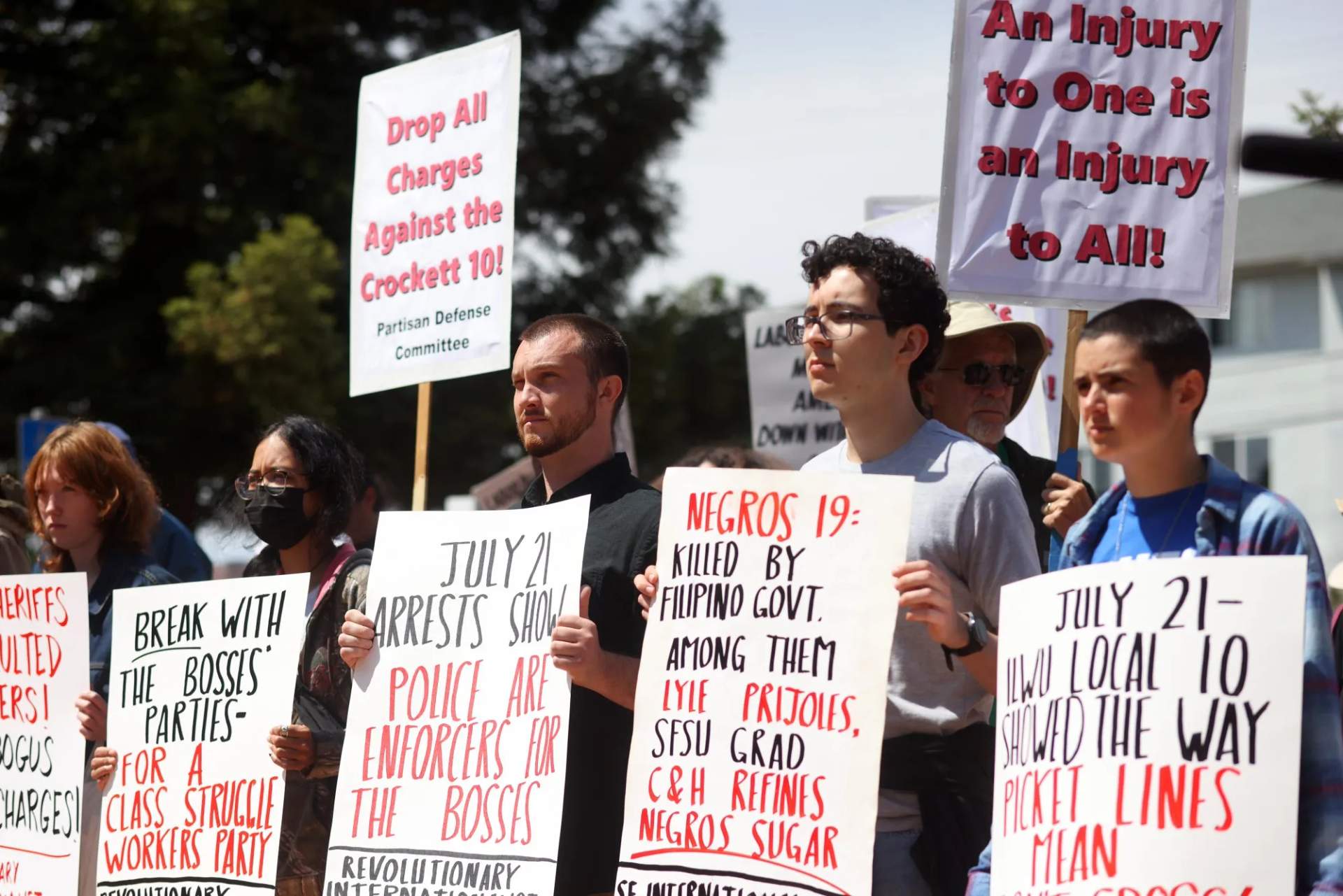
On August 19, supporters packed the courtyard outside the George D. Carroll Court House in Richmond, California, chanting "Defend the Crockett 10" as ten people arrested during a July 21 confrontation on the picket line faced their first court hearing. The Contra Costa County District Attorney's Office still hasn't filed charges. They have a year to do so. For the ten — five ILWU Local 10 members and five affiliated with socialist organizations including the Internationalists Group and the East Bay Internationalist Club — the threat of prosecution hangs overhead like a blade.
"This is the capitalist system of injustice that they have, where they hold charges like this, trumped up charges, over the heads of Black and Brown people, working-class people, habitually," said Will Wright, 29, one of the arrested, speaking to the crowd after the hearing. "We will be back and we will continue to fight and defend the Crockett 10."
A crowd of supporters gathers in a courthouse courtyard holding signs and union flags during a rally for the Crockett 10 in Richmond, California
A Company Town Under Siege
Crockett, population 3,200, was built around the C&H refinery. For most of the 20th century, it functioned as a company town — C&H built homes, parks, swimming pools, athletic facilities. It sponsored Christmas parties. Nearly all refinery workers lived in town. That was before 2005, when American Sugar Refining — now ASR Group — acquired C&H and began the slow work of extraction.
The workforce shrank from 1,500 in 1986 to roughly 500 today. The 2009 contract stripped retiree health and pension guarantees from anyone hired after that year. Workers made concessions. The company came back for more.
"Every three years, we have a contract," said Mario Rivas, a crane operator who has worked at C&H for a decade. "There's always a give and take. This year was the first year there was no negotiation — it was basically, 'We want to take everything you guys have.'"
ASR Group is controlled by the Fanjul brothers — Alfonso, José, Alexander, and Andrés — whose family owned sugar plantations in pre-revolutionary Cuba until Fidel Castro's government expropriated their holdings in 1959. They rebuilt their empire in Florida, amassing a multibillion-dollar sugar monopoly shielded by U.S. tariffs, import quotas, and federal subsidies. ASR owns Domino, Florida Crystals, Redpath, C&H, and the American subsidiary of Tate & Lyle. Alfy Fanjul funds Democrats. Pepe Fanjul funds Republicans. They are major allies of Donald Trump and key bankrollers of the right-wing Cuban-exile political machine.
To lead the C&H negotiations, ASR brought in Rene Ruiz, chief labor counsel for the parent company. His official bio boasts that he "trains employers on union avoidance and strike preparation." The workers of Crockett were not dealing with local management making difficult decisions. They were dealing with a monopoly that had a playbook.
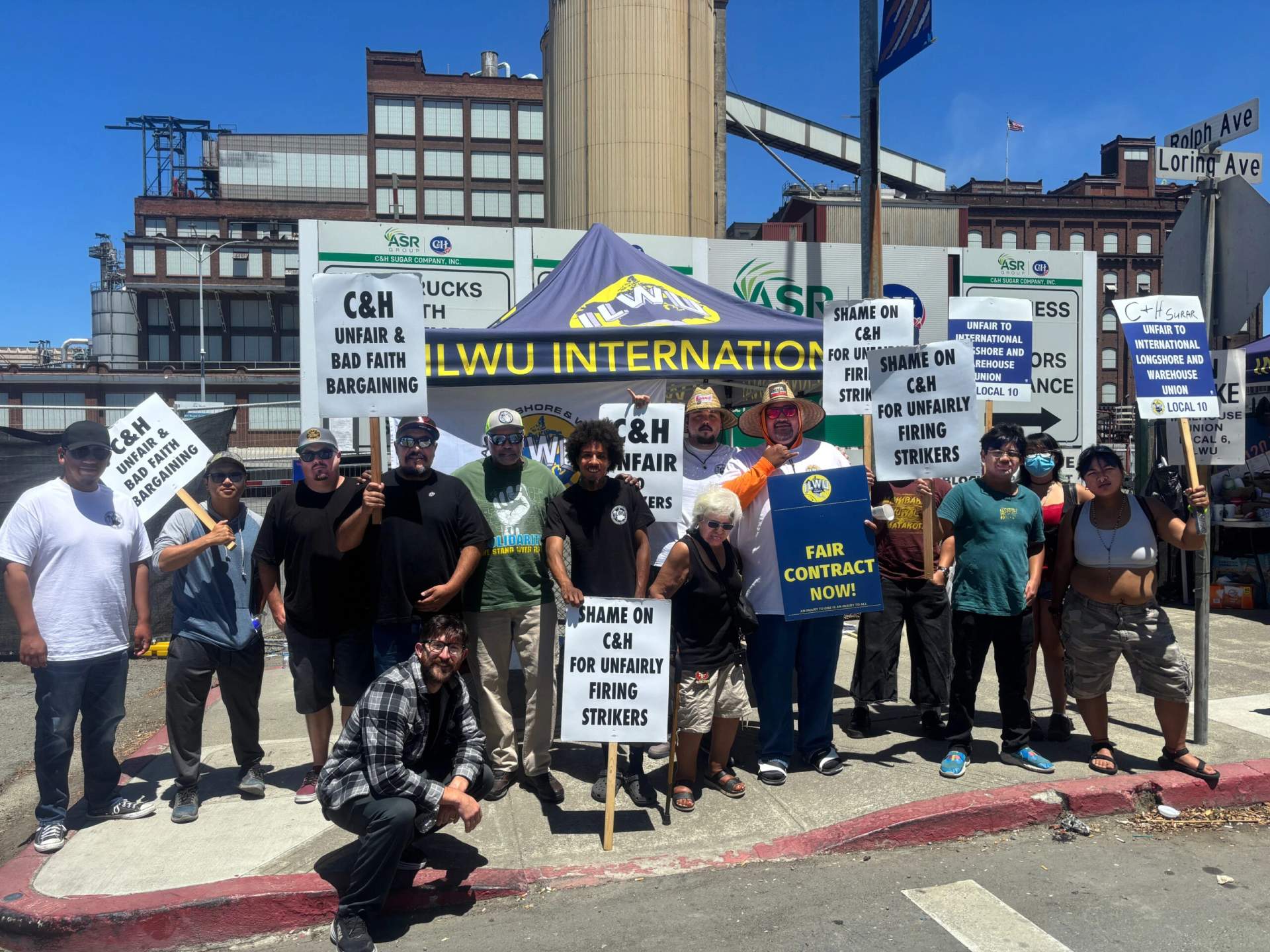
A group of ILWU members and supporters stand on a street holding signs and union banners outside an industrial refinery with a water tower in the background in Crockett California
July 21: Scabs, Batons, and Handcuffs
By mid-July, C&H had begun bussing in replacement workers at $1,700 a week through non-union limousine services — money the company was willing to spend on breaking the strike but not on the contract workers were asking for. Even a conservative estimate of 50 replacement workers over the full 42-day strike would put the scab operation north of $500,000. C&H also tapped Operating Engineers Local 3 to unload raw sugar at the Levin-Richmond Terminal after ILWU longshore workers refused to cross the picket. Meanwhile, 250 production workers at the refinery, represented by the Sugar Workers Association affiliated with the Seafarers International Union, crossed Local 6's picket line for the duration of the strike, allowing a reduced level of refining to continue. A cargo ship carrying raw sugar from the Philippines sat anchored in San Francisco Bay for ten days because ILWU Local 10 longshore workers refused to cross Local 6's picket line to unload it — honoring one of the ILWU's ten guiding principles: "every picket line must be respected as though it were our own."
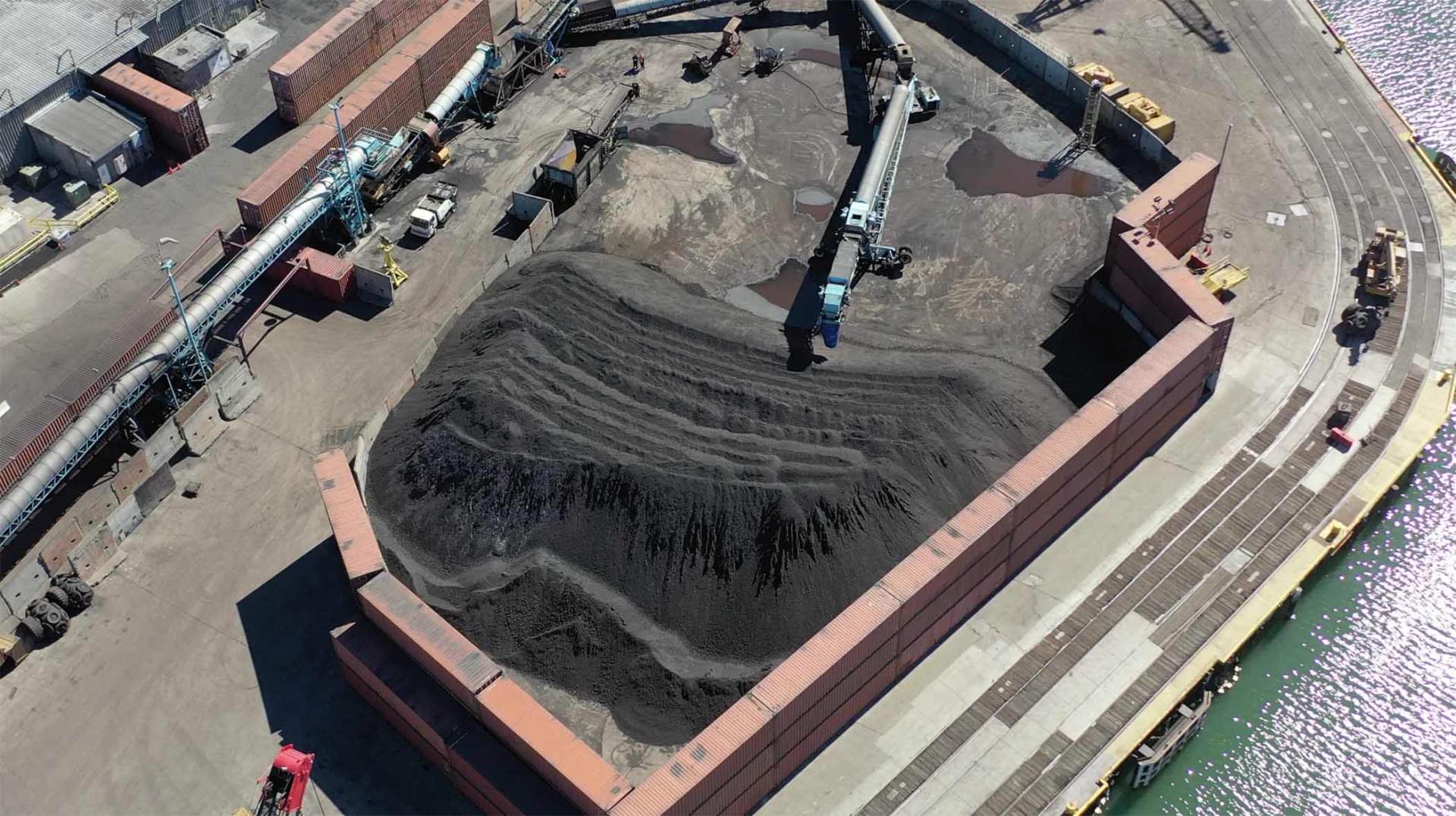
Aerial photograph of the Levin-Richmond Terminal industrial waterfront showing large piles of coal, conveyor systems, and storage structures along San Francisco Bay
C&H rerouted the sugar to the Levin-Richmond Terminal, a private dry-bulk port that handles scrap metal, cement, coal, and petroleum products. It sits on a site declared a Superfund zone due to rampant DDT contamination. Richmond City Councilmember Claudia Jimenez raised the alarm: "Sugar, which is a food product, is being dumped here next to petroleum and coal products." City inspection staff confirmed they observed raw sugar piled directly on the terminal's ground. The coal stored at the site isn't covered. The wind blows across the wharf.
ILWU Local 10 president Michael Villeggiante described what union members saw: the sugar being moved by bulldozers and conveyor belts that also handle scrap metal and cement, with hydraulic fluid and oil visible on the ground. "Some of this stuff can be refined out. But some of it can't. Cement products, petroleum products cannot be refined out," he said. Jimenez contacted the Contra Costa County Health Department to investigate. C&H's response: raw sugar is not food grade until it passes through a refinery, and "once it has been processed in our refinery, we assure the quality of our finished sugar."
No California food safety agency or the FDA has publicly confirmed or denied that the rerouted sugar entered the consumer food supply. The question — did contaminated sugar reach American kitchens? — remains unanswered, and C&H declined to address it when asked directly.
On July 21, things came to a head. Striking members of Local 6 and solidarity strikers from Local 10 were picketing the refinery entrances to confront the scabs when two trucks plowed into the picket line. Workers were injured. One was hospitalized.
"You can see from the turnout of the police, there's two things that are bothering the cops: Number one, we're working people and number two, we're Black and people of color," said Clarence Thomas, an ILWU Local 10 retiree, speaking on the Work Week Radio podcast. "It has taken longshore workers exhorting the police to do their job, which is to arrest someone who has hit a pedestrian with a vehicle intentionally."
Instead of arresting the driver who struck workers with his vehicle, Contra Costa County Sheriff's Sgt. Daniel Marzilli arrived with more than a dozen vehicles, armed deputies, batons, and tear gas. He declared the picket an unlawful assembly and ordered dispersal — warning of "less lethal munitions, chemical agents or police dogs." Ten people were arrested and handcuffed. Six were booked at the Martinez Detention Facility on suspicion of remaining at an unlawful assembly. Some face potential charges for battery, obstruction, and resisting a police officer.
The police taped off the picket area with yellow tape. The scabs kept working.
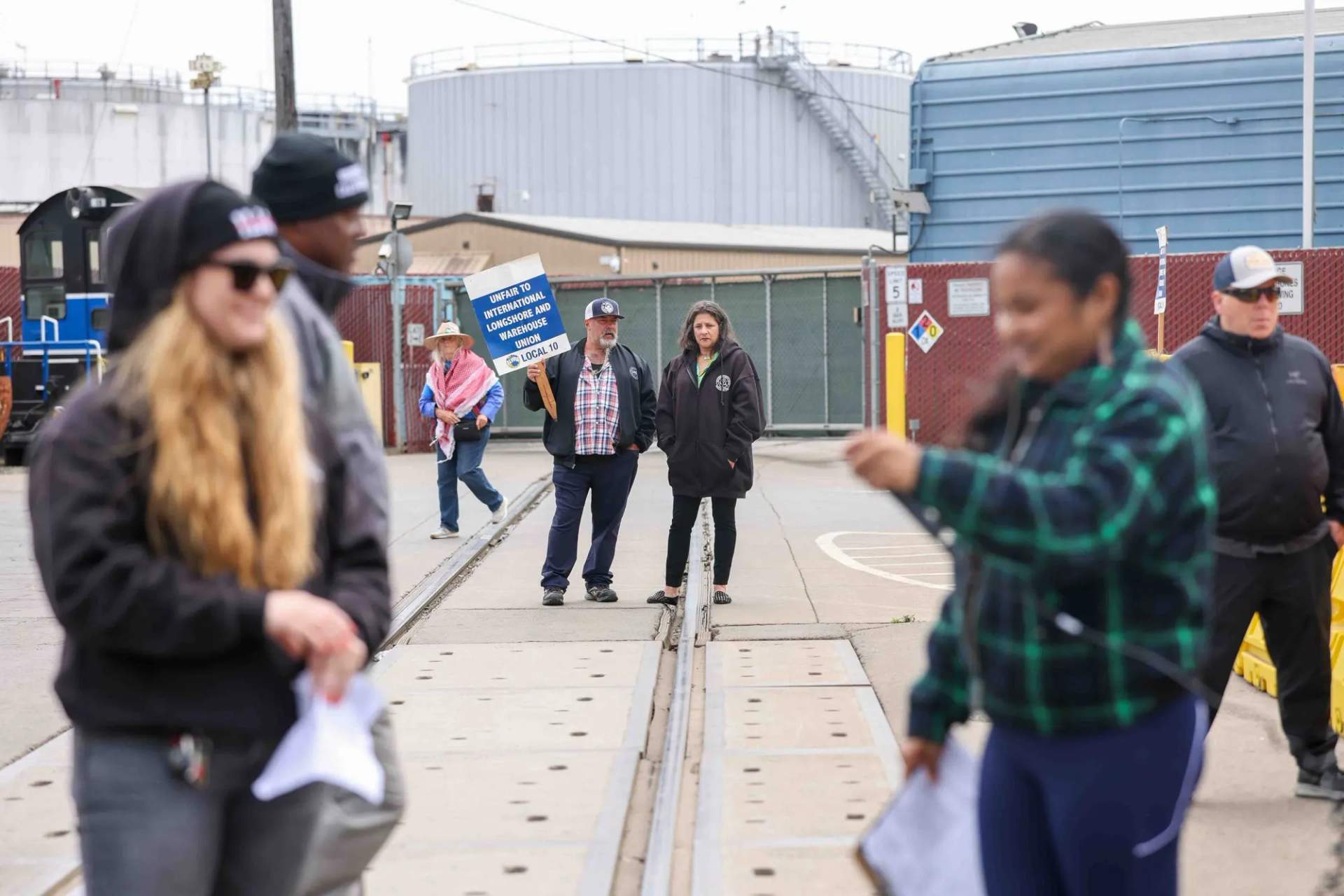
Union workers and supporters gather near the waterfront at a rally in Richmond CA holding signs and ILWU flags during the C&H Sugar strike
Who Are the Crockett 10?
The Crockett 10 are not C&H employees. They are ten people arrested on July 21 for the crime of standing on a picket line — five members of ILWU Local 10, the longshore union that refused to cross Local 6's picket, and five community supporters affiliated with socialist organizations, including the Internationalists Group and the East Bay Internationalist Club. Among them is Will Wright, 29, who has become a public face of the defense campaign.
The charges are a case study in how the legal system criminalizes solidarity. When scab trucks plowed into the picket line, injuring and hospitalizing workers, no driver was arrested. Instead, Contra Costa County Sheriff's Sgt. Daniel Marzilli declared the picket an unlawful assembly and sent in more than a dozen vehicles, armed deputies, batons, and tear gas. One Local 10 member spent the night in the hospital after deputies threw him into glass, cutting his face. Three others spent the night in custody at the Martinez Detention Facility before being bailed out the next morning.
The Contra Costa County District Attorney's Office — led by Diana Becton, the first woman and first Black person to hold the office — has not filed charges. Under California law, they have up to a year to do so. At the August 19 hearing at the George D. Carroll Court House in Richmond, the ten were told to call every three weeks to check whether the DA has decided to prosecute. No charges. No resolution. Just the indefinite threat of prosecution hanging over their heads — which, for the state, may be the entire point. No known connection exists between the Fanjul family and the Contra Costa DA's office. The Fanjuls' political operation is concentrated in Florida and federal races — they have donated over $7 million to Trump fundraising committees and super PACs alone. But the family has also poured millions into both major parties nationwide through their corporate entity, Fanjul Corp. The structure of power doesn't always require a direct phone call. Sometimes the message is already delivered by the political culture that people like the Fanjuls help manufacture: labor is a cost, and those who defend it are a problem.
Wright described it from the courthouse steps: "They tried to demonstrate the union principle: picket lines mean don't cross. So the arrests that day were in effect, revenge for that action."
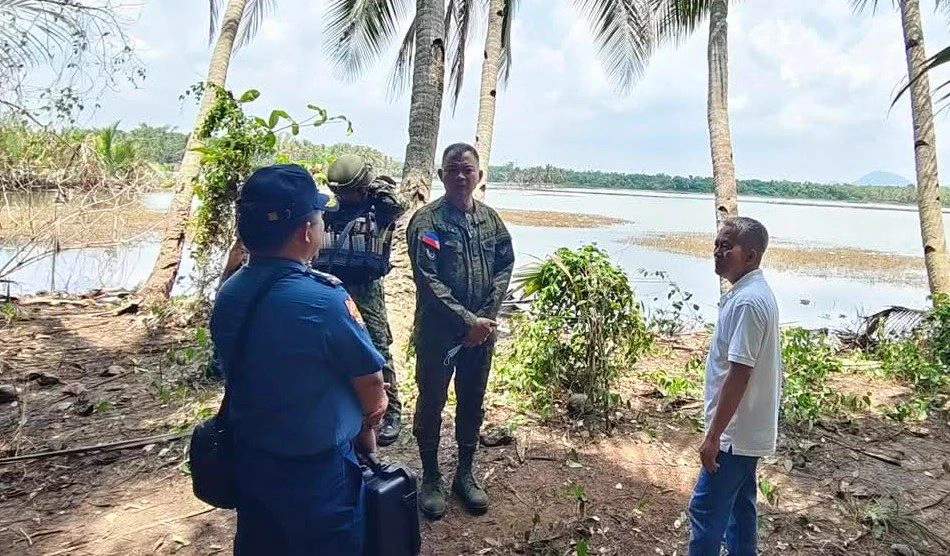
Brig. Gen. Ted Dumosmog, commander of the 303rd Infantry Brigade, and Toboso Mayor Richard Jaojoco inspect the scene of the slaughter in northern Negros, where 19 were massacred by the military.
The Negros 19: Blood in the Supply Chain
The sugar processed at the Crockett refinery comes overwhelmingly from the Philippine island of Negros Occidental, where roughly 60 percent of the land is dedicated to sugar cane and a farmer earns less than a dollar a day. This is not a footnote to the strike. It is the strike's other half.
On April 19, 2026 — less than two months before the C&H walkout — the Philippine Army's 79th Infantry Battalion opened fire on a community in Barangay Salamanca, Toboso, killing 19 people. The military called it an encounter with the New People's Army. The Communist Party of the Philippines and the National Fact-Finding and Solidarity Mission identified nine of the dead as civilians, including two University of the Philippines students, a community journalist and poet, a community researcher, a local resident, two minors — and two Filipino-American activists from the Bay Area.
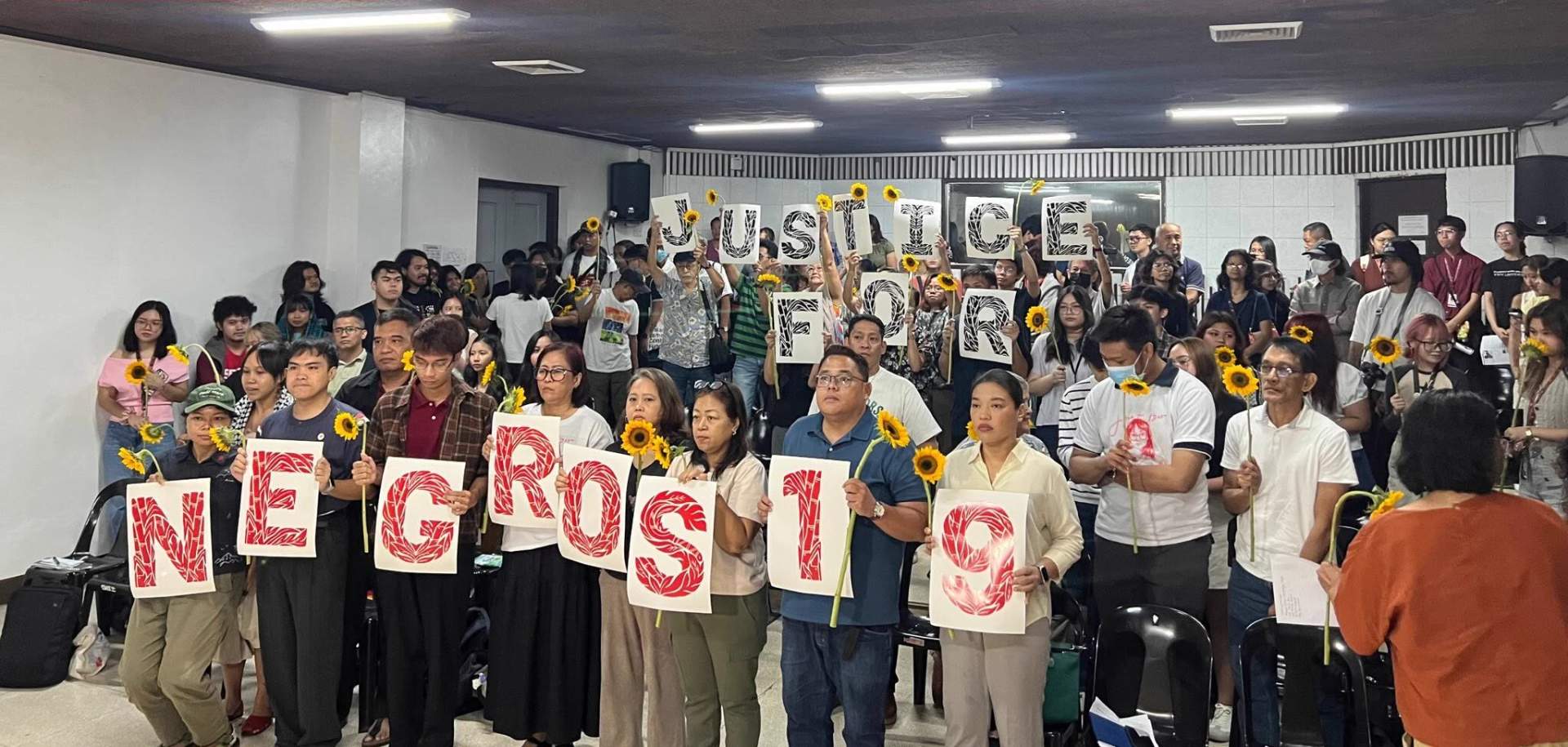
Large group of activists carrying banners and signs marching down a street during a Justice for Negros 19 protest rally
One of them was Lyle Prijoles, 40, a native of the San Francisco Bay Area who had traveled to Negros to document the conditions of sugar workers whose labor feeds C&H's refinery. The other was Kai Dana-Rene Sorem, 26. Both were killed by a military operating with equipment and training provided in part through U.S.-Philippines joint exercises — the same bilateral military framework that C&H's supply chain sits inside.
Ricky Pataksil of Defend Negros Northern California, who had been tracking where Negros sugar ends up, connected the two struggles at the Crockett picket line. A C&H worker told him: "The exploitation starts from the farmers in the Philippines who harvest the sugar and put it on the ship, and then it continues with the workers who process and refine the sugar." As one striker put it: sugar arrives at Crockett "with the price of blood and exploitation of workers both in the Philippines and the Bay Area."
The Filipino community has been a constant presence on the Crockett picket line — a living reminder that the Fanjul brothers' sugar empire does not begin or end in California. It begins in the fields of Negros, where peasants labor for less than a dollar a day under the shadow of a military that has now killed at least 19 people in a single operation, including two Americans who came to bear witness.
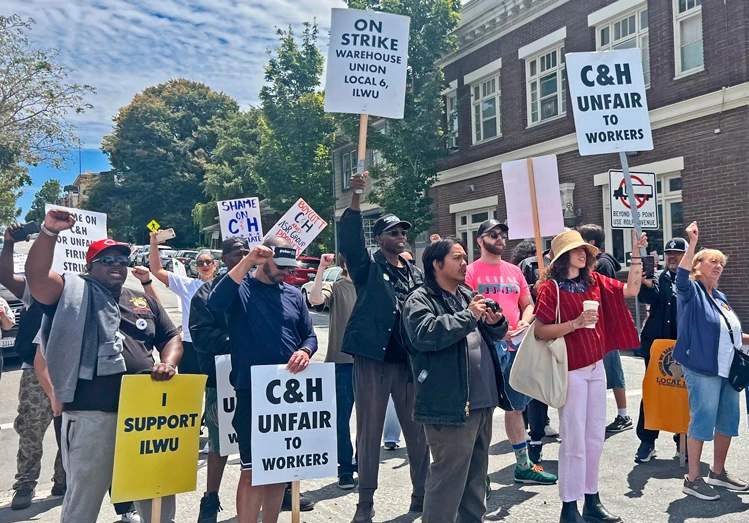
Striking workers hold ILWU union flags and signs on a street near a refinery entrance during the Sugartown Festival in Crockett California
The Stakes Beyond Crockett
The strike ended on July 27, when C&H and the ILWU issued a joint statement announcing a 60-day negotiation period through September 30. Workers returned to their posts under the terms of their old contract. C&H withdrew its declaration of impasse. Federal mediators would be involved. Senior executives from C&H and the ILWU International would participate in negotiations.
"Everybody's positive, everybody believes it's the right thing to do," said Cesar Garibay, a Local 6 negotiator. "We're confident that something will be reached before Sept. 30."
But the union's own statements tell a different story. On July 19, eight days before the return-to-work agreement, the ILWU released a public statement calling out C&H's bad faith: "C&H has turned its back on generations of workers who spent their lives making the company profitable and who live in the very community C&H claims to serve." Chief steward Otis Brown, a 25-year veteran, said: "They told us after one bargaining session that they would not change their offer, and that C&H could take away whatever benefits it wanted."
Three workers were illegally fired on June 24, nine days into the strike, for the crime of walking a picket line. C&H has not publicly identified them, and UnTelevised Media was unable to reach them independently. What is known is this: under federal labor law, terminating workers for engaging in protected strike activity is a violation of the National Labor Relations Act. The workers were on the line — legally, as protected concerted activity — and they lost their jobs for it.
The ILWU filed unfair labor practice charges with the NLRB Region 32 in Oakland on June 26 — two days after the terminations. The charges allege C&H refused to negotiate in good faith, declared a premature impasse, unilaterally implemented contract takeaways, and unlawfully terminated striking workers. As of publication, the NLRB has not yet issued a determination on the charges. If the NLRB finds merit, it could issue a complaint against C&H — a step short of litigation but one that carries legal weight and public exposure. If it finds the charges lack merit, the case closes. The timeline for a regional determination varies, but the charges represent a live federal proceeding, not a resolved chapter.
The union has highlighted one example of what those terminations and the broader contract fight mean in human terms: Larry Morrison, who worked at C&H for 43 years and now faces the loss of retiree medical coverage he spent over four decades earning. The union says there are more like him — workers who gave their working lives to the refinery and are now being told that a promise made across generations can be unmade in a single negotiation cycle.
This is part of a broader pattern of workers across America withdrawing their labor and the system starting to shake. What's happening in Crockett isn't isolated — it's connected to meatpacking workers in Denver voting to strike against corporate meat, to May Day actions where workers took the streets over billionaires, to every front where capital demands concessions and labor refuses to give them.
For the ILWU, this fight carries weight beyond Crockett. Clarence Thomas put it plainly: "Our employers are paying particular attention to our resolve and solidarity in fighting against concessionary bargaining with our Local 6 sisters and brothers at the bargaining table with C&H Sugar. We are trying to let our members know, particularly in Local 10, that this is a test run. If we don't support the Local 6 strike, this will set the stage for what the employers will try to do to the Longshore Division contract negotiations in 2028."
The solidarity has been broad. Hawaii's ILWU Local 142 sent members to the picket line. The Filipino community — connected to C&H's sugar supply chain through the island of Negros, where 19 people were killed by the Philippine Army in April during joint U.S.-Philippines war games, including labor organizer Lyle Prijoles who was documenting sugar worker conditions — has been a constant presence. The Oakland Education Association, ATU Local 192, and the Alameda Labor Council have shown up. At the August 19 courthouse rally, filmmaker and activist Boots Riley stood alongside the Stanford 11 students facing their own charges from a campus protest.
The 60-day clock is ticking. On September 30, the cooling-off period expires. If C&H hasn't moved — if the Fanjul brothers' $1.6 billion empire hasn't found it in itself to honor the healthcare promises it made to workers who spent 30, 40, 70 combined years making their sugar — the picket lines go back up.
And the Crockett 10 still face potential prosecution for the crime of standing with their fellow workers. The DA hasn't filed charges. But the threat is the point. It's the same calculus the Fanjuls understand in their political operations in Florida: power doesn't need to win every fight. It just needs to make the fighting expensive enough that people stop.
The workers of Sugartown haven't stopped.
C&H's Response: Eight Questions, Zero Answers
UnTelevised Media sent eight specific questions to C&H Sugar and ASR Group on August 24, covering the company's bargaining conduct, the unlawful termination of three striking workers, the July 21 incident where scab trucks struck picketers, the rerouting of raw sugar to a contaminated Superfund site, the involvement of a union-avoidance consultant as lead negotiator, proposed overtime changes that would amount to net pay cuts, the elimination of retiree healthcare, and the current status of negotiations.
The reply did not come from C&H. It did not come from ASR Group. It came from Ashley Bauman, a Managing Director at Mercury Public Affairs — a crisis communications firm owned by Omnicom Group, one of the world's largest corporate PR conglomerates. ASR Group had outsourced their response to a hired gun.
Bauman forwarded a single statement attributed only to "a spokesperson from C&H:"
"C&H Sugar values our employees and their families, and we take pride in providing hundreds of good-paying American manufacturing jobs with excellent benefits. C&H resumes negotiations in good faith and is committed to an open and constructive dialogue to reach an agreement that supports our employees while ensuring the long-term sustainability of our company and the communities we serve."
Every question was dodged. No company executive would go on the record. The statement is boilerplate — the kind of language a PR firm could produce for any labor dispute in America without changing a single word. Workers facing the elimination of their healthcare after 30 years of service got "we take pride in providing excellent benefits." A company whose lead negotiator trains employers in union avoidance got "resumes negotiations in good faith." A corporation controlled by billionaires with a combined net worth exceeding $1.6 billion got "long-term sustainability of our company and the communities we serve."
Who is Ashley Bauman? She is not a C&H employee. She is not an ASR Group employee. She is a Managing Director at Mercury Public Affairs, a bipartisan lobbying and crisis communications firm headquartered in New York and owned by Omnicom Group — a publicly traded corporate communications holding company (NYSE: OMC) with roughly $15 billion in annual revenue and operations in over 100 countries. Omnicom is the parent of agencies like BBDO, DDB, TBWA, and FleishmanHillard. Mercury itself operates offices in Washington D.C., Sacramento, and half a dozen other cities, offering corporate reputation management, crisis communications, litigation strategy, and government relations. Its client roster includes corporations facing the kind of scrutiny C&H is now facing — and its job is to make that scrutiny go away.
Bauman's own background is in political communications, not labor relations. She spent nearly two decades in Democratic Party politics, serving as a senior communications adviser to the DNC chair, running digital and media operations for Barack Obama's 2008 and 2012 presidential campaigns, and directing marketing and communications for the City of Tampa under Mayor Jane Castor. She is a professional message-crafter — someone whose career has been built on shaping narratives for powerful institutions. That is the skill set ASR Group hired. Not someone to answer questions. Someone to manage a crisis.
This is how billion-dollar corporations handle scrutiny. They don't explain. They outsource. No executive at C&H Sugar or ASR Group would attach their name to a single sentence about the strike. Instead, they hired a multinational PR conglomerate to send a paragraph that could have been generated by a chatbot. The workers of Crockett — who put their names, their faces, and their bodies on the line — deserved better. They didn't get it.
The Contra Costa County District Attorney's Office declined to comment on the Crockett 10 case. ILWU Local 6 did not respond to requests for comment by publication time.
Sources & Methodology(18 sources)
- Mercury News — Crockett 10 Court RallyNews Article
- Local News Matters — Striking Workers ReturnNews Article
- The Militant — C&H Workers Win SolidarityNews Article
- Bay Area Current — Sugartown Is on StrikeNews Article
- NLRB — ULP Case (Region 32, Oakland)Data
Unfair labor practice charges filed by ILWU Local 6 on June 26, 2026, alleging bad-faith bargaining, premature impasse declaration, unilateral implementation of contract takeaways, and unlawful termination of three striking workers. A previously cited case number (32-CB-311238) was verified September 7, 2026 as an unrelated closed 2023 case; the 2026 case number is not publicly indexed by the NLRB.
- KQED — Arrests, Injuries at C&H Sugar ProtestNews Article
Reports on C&H rerouting raw sugar to the contaminated Levin-Richmond Terminal. Richmond City Councilmember Claudia Jimenez raised cross-contamination concerns. City staff inspected and observed sugar on the ground near uncovered coal. County Health Department contacted.
Covers the diverted sugar shipment from the Tai Herald, contamination concerns at Levin-Richmond Terminal, Defend Negros Coalition involvement, and ILWU Local 10 president Villeggiante's account of sugar being moved by bulldozers and conveyor belts used for industrial materials.
Reports that the Fanjul brothers have donated over million to Trump fundraising committees and super PACs over the last decade, and details the Fanjul-Sugar connection to forced labor conditions.
Methodology
This article is based on reporting from the Mercury News, Struggle-La Lucha, CounterPunch, FreightWaves, The Militant, Bay Area Current, Bulatlat, Workers Vanguard, KQED, ABC7 News, NBC Bay Area, ILWU official press releases, NLRB public records, Wikipedia (Toboso encounter), ASEAN Parliamentarians for Human Rights, Corporate Accountability Lab, and a right-of-reply statement from C&H Sugar forwarded by Mercury Public Affairs (Omnicom Group). ILWU Local 6 was contacted for comment on August 24, 2026. C&H Sugar and ASR Group were contacted with 8 specific questions; their response — a single generic statement forwarded by a hired crisis-PR firm — addressed none of the questions. The Contra Costa County DA declined to comment. The three terminated workers were not publicly identified by C&H; UnTelevised Media was unable to reach them independently.
Filed Under
Frequently Asked Questions
- What is the C&H Sugar strike about?
- Approximately 100 ILWU Local 6 warehouse workers at C&H Sugar's refinery in Crockett, CA went on strike June 15, 2026 after ASR Group (C&H's parent company, controlled by the billionaire Fanjul brothers) proposed a contract that would eliminate retiree healthcare benefits, slash overtime pay, gut seniority protections, halve sick leave, and impose unfair weekend scheduling. The company offered a 20% raise over five years that doesn't come close to making up for the benefits taken away.
- Who are the Crockett 10?
- Ten people arrested on July 21, 2026 during a picket line confrontation at the C&H Sugar refinery. Five are ILWU Local 10 members who refused to cross the picket in solidarity with striking Local 6 warehouse workers. The other five are community supporters affiliated with socialist organizations including the Internationalists Group and the East Bay Internationalist Club. The Contra Costa County DA has not filed charges but has up to a year to do so. No driver who struck picketers with a vehicle was arrested; instead, the picketers were arrested and one was hospitalized after deputies threw him into glass.
- Who owns C&H Sugar?
- C&H Sugar is owned by ASR Group (American Sugar Refining), the world's largest cane sugar refiner. ASR is controlled by the Fanjul brothers — Alfonso, José, Alexander, and Andrés — whose family owned sugar plantations in pre-revolutionary Cuba until 1959. They rebuilt a multibillion-dollar empire in Florida shielded by U.S. tariffs, import quotas, and federal subsidies. ASR also owns Domino, Florida Crystals, Redpath, and Tate & Lyle's American subsidiary. The Fanjuls have donated over million to Trump fundraising committees and super PACs and pour millions into both major parties.
- What is the current status of the strike?
- Workers returned to their jobs on July 29, 2026 under a 60-day negotiation period extending through September 30. C&H withdrew its declaration of impasse and both sides agreed to continue bargaining with federal mediators and senior executives involved. If no deal is reached by September 30, workers may strike again. NLRB Region 32 in Oakland is investigating unfair labor practice charges filed June 26, including allegations of bad-faith bargaining, premature impasse, unilateral contract implementation, and unlawful termination of three striking workers.
- What happened on July 21 at the refinery?
- Scab trucks plowed into the picket line, injuring workers and hospitalizing at least one. Instead of arresting the driver, Contra Costa County sheriffs declared an unlawful assembly and arrested ten picket supporters. Workers and witnesses described the response as punishment for union solidarity rather than protection of public safety. One Local 10 member was hospitalized after deputies threw him into glass. Three others were held overnight at the Martinez Detention Facility.
- Who are the Negros 19?
- Nineteen people killed on April 19, 2026 when the Philippine Army's 79th Infantry Battalion opened fire in Barangay Salamanca, Toboso, Negros Occidental — the Philippine province where most of C&H's raw sugar is grown. The military called it an encounter with the New People's Army. A fact-finding mission identified nine of the dead as civilians, including two University of the Philippines students, community journalist RJ Ledesma, community researcher Errol Wendel, two minors, a local resident, and two Filipino-American activists: Lyle Prijoles (40, Hayward, CA) and Kai Sorem (26, Washington state). Prijoles had traveled to Negros to document sugar worker conditions.
- Was sugar processed at a contaminated site?
- After ILWU longshore workers refused to cross the picket line, C&H rerouted a cargo ship carrying raw Philippine sugar to the Levin-Richmond Terminal — a private industrial port that handles coal, petroleum, cement, and scrap metal on a Superfund-contaminated site. Richmond City Councilmember Claudia Jimenez confirmed city staff observed sugar piled on the ground near uncovered coal. ILWU Local 10 president Michael Villeggiante reported seeing sugar moved by bulldozers and conveyor belts also used for industrial materials, with hydraulic fluid and oil visible on the ground. C&H claimed the sugar would be safe after refining. No state or federal food safety agency has publicly confirmed or denied whether the rerouted sugar entered the consumer food supply.
- What are the NLRB charges against C&H?
- ILWU Local 6 filed unfair labor practice charges with NLRB Region 32 in Oakland on June 26, 2026, two days after C&H terminated three striking workers.
- Who responded to UnTelevised Media's questions on behalf of C&H?
- The reply came from Ashley Bauman, a Managing Director at Mercury Public Affairs — a crisis communications firm owned by Omnicom Group (NYSE: OMC, ~$15 billion annual revenue, operations in 100+ countries). Bauman is not a C&H or ASR Group employee. Her background is in Democratic Party politics: she served as senior communications adviser to the DNC chair, ran digital operations for Obama's 2008 and 2012 campaigns, and directed marketing for the City of Tampa. ASR Group forwarded UnTelevised Media's eight specific questions to Mercury rather than answering directly. The single generic statement they returned addressed none of the questions. No C&H or ASR executive went on the record.