
The System Works for Cops, Not for the Dead
On August 4, 2021, Denver District Attorney Beth McCann released her decision letter on the police killing of Duane "DJ" Manzanares Jr. Her conclusion was predictable for anyone who has watched how the criminal legal system processes police violence in America: the shooting was "legally justified." No criminal charges. No accountability. No justice.
Three officers — Samuel Bailey, Ryan Nelson, and Steven Whiteman — shot DJ 11 times on a public sidewalk on June 13, 2021. They killed a 30-year-old father who was in Denver because his 8-year-old son had just been diagnosed with acute leukemia. DA McCann's review, which took less than two months, concluded that the officers made a "split-second decision" and that their actions were justified under Colorado law.
DJ's mother, Mary Ann Medina-Trujillo, attended the DA's presentation on the findings and watched the body camera footage that police had withheld from the family for weeks. Her response cut through the bureaucratic language: "I watched the video. It was a disgusting display of organized crime. They cold-blooded murdered my son."
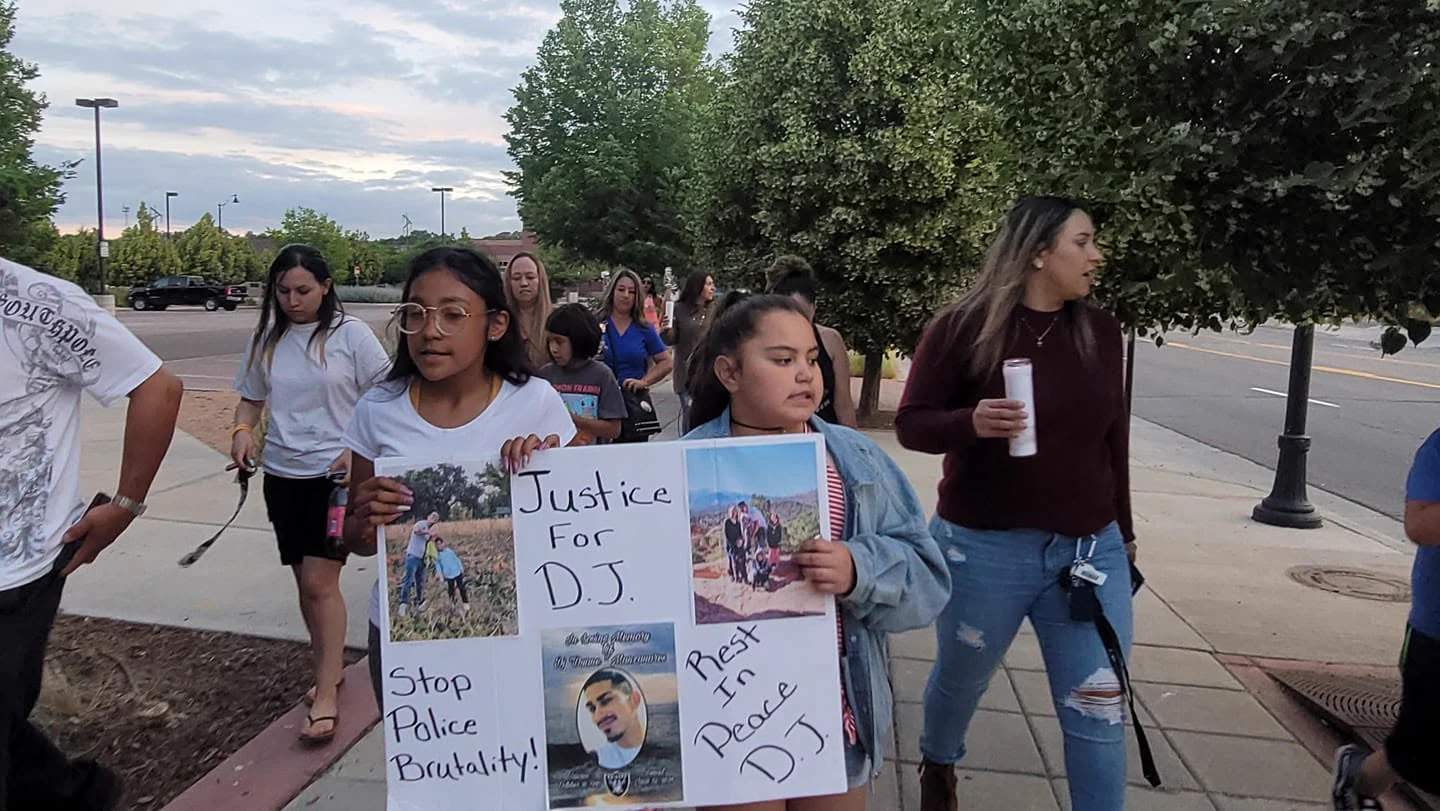
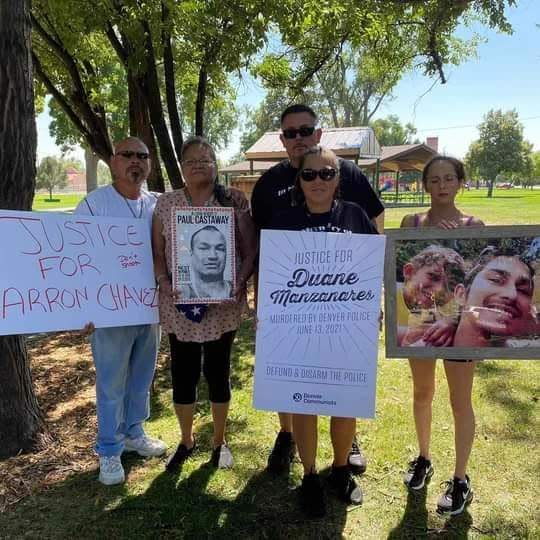
Family of DJ protest for justice in his murder by Denver PD.
The Family Fights Back
While the DA's office was preparing to exonerate the officers, DJ's family was already in the streets demanding answers.
On August 1, 2021, less than seven weeks after the killing, the family held a rally and march in Pueblo to demand accountability. The crowd gathered near the Pueblo Police Department headquarters, carrying signs and demanding transparency from Denver investigators.
Medina-Trujillo spoke to KRDO News at the rally, expressing the family's mounting frustration. "They haven't even released any footage to us. We have had no police footage released. We haven't found out about his property, anything. There is no communication. We had to find out by the Internet that he had passed away."
The family's demands were simple: release the body camera footage, identify the officers by name, and provide a transparent investigation. For nearly two months, they received none of these things.
DJ's girlfriend, Lareina Ford, was blunt about the family's commitment. "Until we hear something back and something is done. Yeah, we are going to keep on protesting," she told reporters. The family also launched a GoFundMe campaign titled "Justice for Duane & Damien" to cover funeral expenses and support Damien's years-long leukemia treatment.
A separate Facebook event called for a "March for Justice for Duane 'DJ' Manzanares — Murdered by Denver Police" on East Colfax Avenue in Aurora, near the site of the killing. The community mobilization was building momentum, but the institutional response was already calcifying in the officers' favor.
McCann Clears the Officers: A Predictable Script
DA McCann's August 4 decision letter followed a formula that Colorado residents have seen repeated dozens of times when police kill civilians.
The letter acknowledged the basic facts: Manzanares had a handgun tucked into his waistband; officers saw the grip of the weapon; they ordered him to put his hands up; he was "argumentative" and "agitated"; he dropped a bottle of whiskey and reached toward his waistband; officers fired.
What the letter did not address — what these letters almost never address — is whether there were alternatives to lethal force. Whether the officers could have maintained distance and de-escalated. Whether 11 rounds into a man who was carrying a bottle, not actively firing a weapon, was a proportional response. Whether the context — a grieving father whose son was in the ICU — should have informed the officers' approach.
The letter did not grapple with why three officers with their weapons drawn could not safely contain a single man without killing him. It did not question the training protocols that led to an execution-style volley of gunfire. It did not consider the devastating human cost — an 8-year-old boy with leukemia who would now grow up without his father.
Instead, McCann relied on the legal standard that has shielded police from accountability for generations: the "split-second decision" defense. Under this framework, as long as an officer can articulate a fear for their safety — no matter how quickly that fear crystallized or whether it was reasonable — the shooting is deemed legally justified.
Colorado law provides minimal checks on this power. Despite reforms in recent years — including a landmark 2020 law that eliminated the qualified immunity defense in state civil rights claims — criminal prosecutions of police for on-duty killings remain vanishingly rare in Colorado. District attorneys, who depend on police cooperation for their cases, have little institutional incentive to pursue charges against officers.
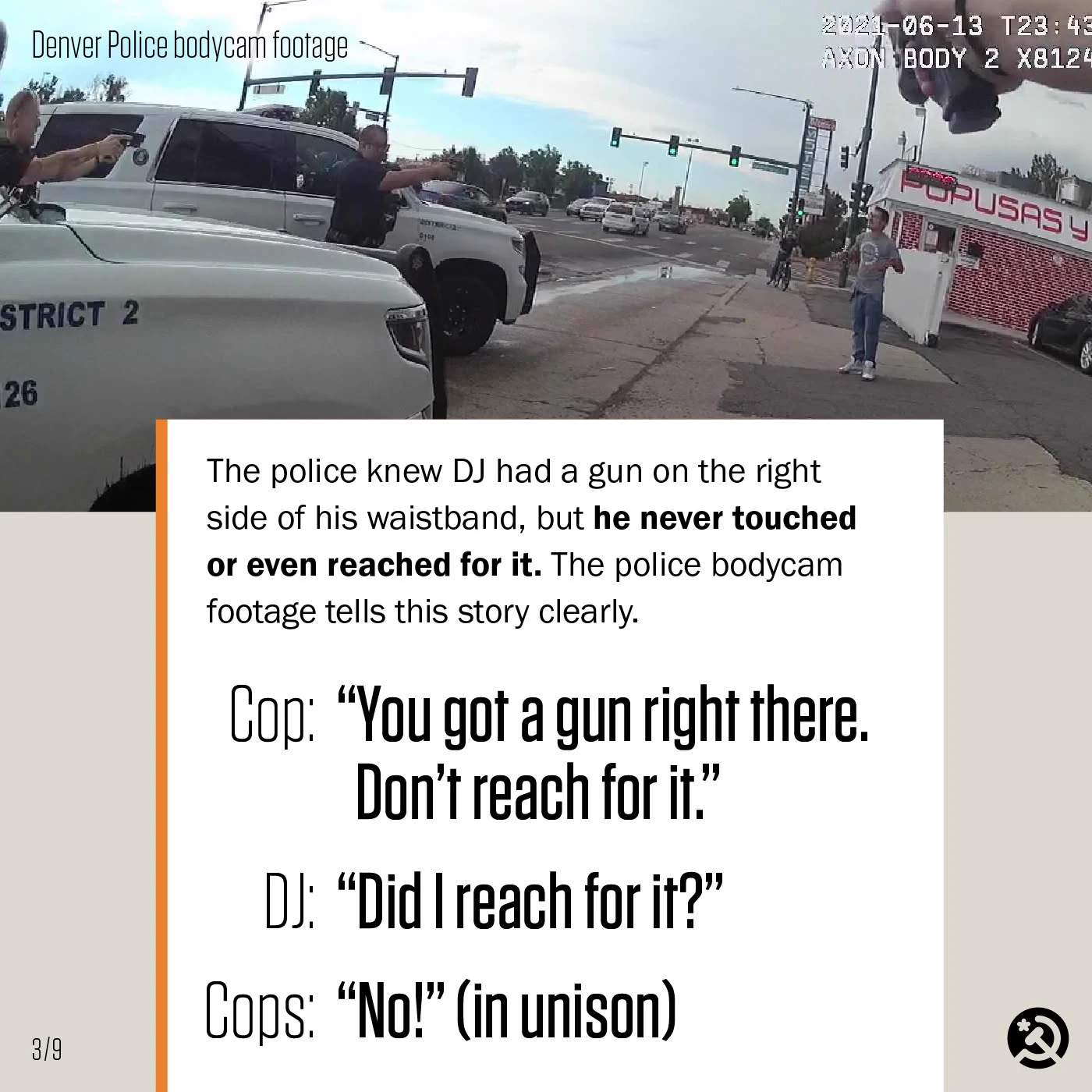
Image showing Denver police drawing weapons on DJ despite him never reaching for his weapon.
The Institutional Shield: Modified Duty and Secrecy
From the moment DJ Manzanares was killed, the system moved to protect the officers, not the victim or his family.
All three officers — Bailey, Nelson, and Whiteman — were placed on "modified duty assignment" with pay. In the DPD's terminology, this means they continued to receive their salaries while being reassigned from patrol duties. None of the officers faced suspension without pay, administrative charges, or any form of disciplinary consequence.
The department also shielded the officers' identities for nearly two months. The family publicly complained that they did not even know the names of the men who had killed DJ. "We don't even know who the police officers were that shot him," Medina-Trujillo said. "They haven't given their names. They are all shielded and protected behind their badges but we are out here in the open trying to get answers."
Body camera footage — the single most important piece of evidence in any police killing investigation — was withheld from the family and the public for weeks. When it was finally shown, it was shown in a controlled DA's office presentation, not released publicly. The family was allowed to watch it once, under supervision, with no ability to share or review it independently.
This pattern of institutional protection is not unique to the Manzanares case. It is the default response of American policing to police violence: isolate the officers, control the narrative, withhold evidence, and let the institutional machinery grind toward exoneration while the family's trauma compounds with each passing day.
A DA's Record on Police Accountability
Beth McCann's decision in the Manzanares case did not occur in a vacuum. It is part of a long record of declining to prosecute Denver police officers for killings.
During her tenure as Denver District Attorney, McCann has reviewed dozens of officer-involved shootings. She has almost never filed criminal charges. The exoneration of officers in both the Manzanares and Wright cases — two men killed within weeks of each other — was announced on the same day, a signal that these were not careful, case-by-case analyses but the output of a system designed to protect police from legal consequence.
Shannon Wright, 29, was killed on May 30, 2021 — two weeks before DJ — after he took items from a liquor store while carrying an assault rifle and told the clerk he was "out shooting cops." Wright pointed the rifle at officers before they fired. The DA cleared the officers in that case as well. McCann announced both decisions on August 4, 2021, and scheduled a single community meeting for August 17 to present her findings — one meeting for two dead men.
The community meeting was held via Microsoft Teams, a format that limited public participation and ensured the proceedings could be controlled. It was not a hearing. It was not a forum for accountability. It was a presentation of a conclusion that had already been reached.
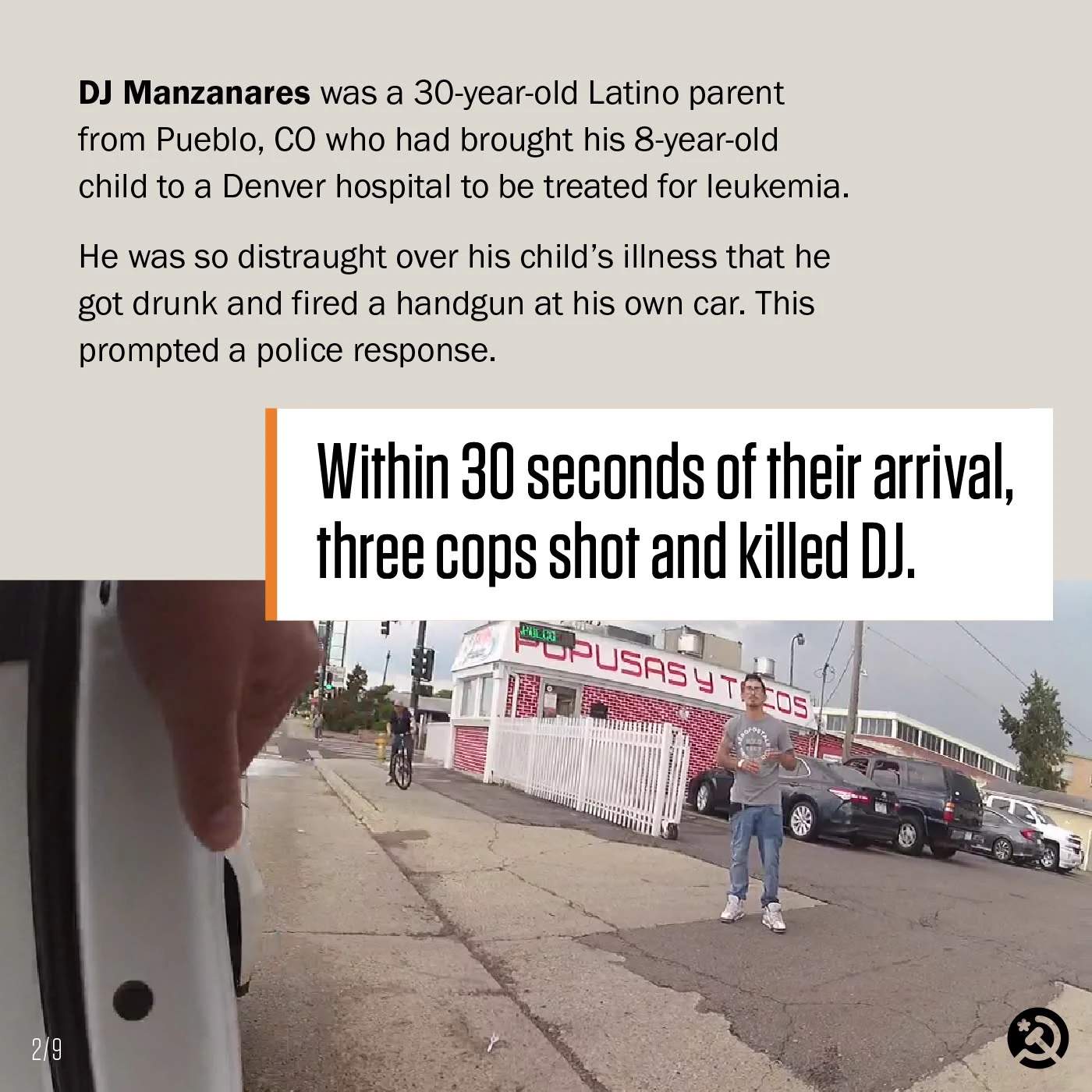
Police Approaching DJ showing him to decently calm
No Grand Jury. No Independent Investigation.
In Colorado, police killings are investigated by the district attorney's office in the jurisdiction where the killing occurred. This means the same prosecutors who work with Denver police officers on a daily basis — who depend on their testimony to secure convictions, who rely on their cooperation — are tasked with deciding whether those same officers committed crimes when they kill civilians.
There was no independent investigation into DJ Manzanares's death. No grand jury was convened. No special prosecutor was appointed. No external law enforcement agency was brought in to review the evidence. The Denver DA's office investigated the Denver Police Department, and the Denver DA's office found no wrongdoing.
Colorado does not have a statewide independent prosecutor for police killings. The state does not require grand juries for fatal police shootings. The reforms passed in 2020 — significant as they were — did not fundamentally alter the architecture of police accountability in the state. The system still investigates itself.
The Family Continues the Fight
Despite the DA's decision and the institutional barriers stacked against them, DJ Manzanares's family has refused to let his name fade into the pile of victims of American police violence.
Mary Ann Medina-Trujillo, who is now the primary caregiver for her critically ill grandson Damien along with three other children who depend on her, has continued to speak publicly about what happened to her son. Lareina Ford has continued to organize and protest. The family's GoFundMe has raised funds to support both funeral expenses and Damien's ongoing medical care — a cruel financial burden imposed by the state that killed DJ in the first place.
The family has also pursued civil litigation. In June 2023, a civil lawsuit was filed in Denver District Court against the city and the officers involved. In March 2025, Denver City Council approved an $800,000 settlement — a figure that, while significant, cannot replace a father's presence in his son's life during years of cancer treatment.
DJ's killing also occurred against the backdrop of a national reckoning with police violence that erupted after the murder of George Floyd in May 2020. That reckoning produced promises of reform across the country. In Denver, those promises have not translated into accountability for the officers who killed DJ Manzanares.
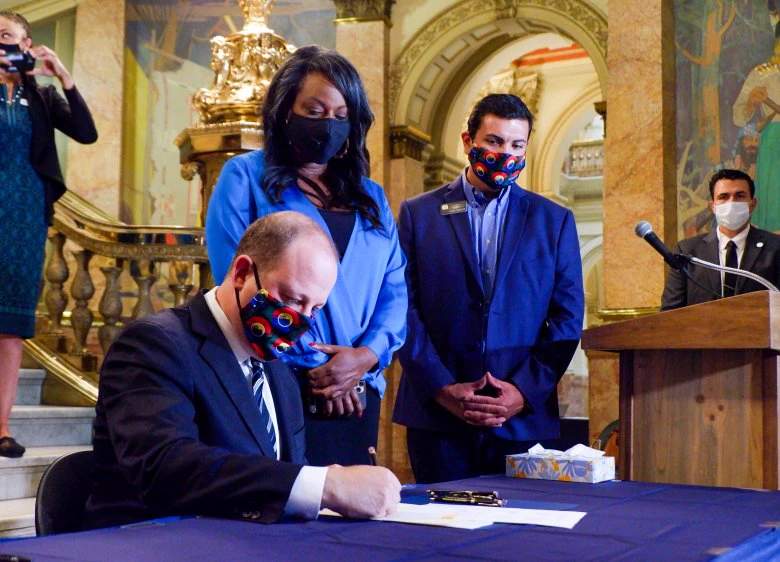
Colorado Governor Jared Polis signs the police accountability bill SB217 in 2020 with legislators and reform advocates
What Accountability Looks Like When the System Works
The case of DJ Manzanares illustrates the gap between the promise of police reform and the reality of police accountability in Colorado and across America.
Reforms can change laws. They can eliminate qualified immunity in civil cases, mandate body cameras, require reporting of use-of-force incidents. But they cannot — on their own — overcome a system in which prosecutors investigate the same police they depend on, in which officers are shielded by anonymity and administrative leave, in which body camera footage is controlled and withheld, and in which grieving families are forced to learn their loved ones are dead from internet videos.
The officers who killed DJ Manzanares have faced no criminal charges. They have faced no public discipline. Their names were hidden for weeks. Their body camera footage was suppressed. The district attorney who reviewed their actions is the same district attorney who needs their cooperation to prosecute cases.
Duane "DJ" Manzanares Jr. was a father, a son, a brother, and a man whose life mattered. His son Damien, now facing years of leukemia treatment without his father, deserves more than a settlement check. He deserves a world where police cannot kill his father with impunity and face no consequences.
Justice for DJ means confronting the system that killed him — and that system's name is the American criminal legal system itself.
Sources & Methodology(8 sources)
Methodology
This article was reported using Denver District Attorney decision letters, family statements, protest coverage from KRDO and local outlets, Denver Post and Denver Gazette reporting, Colorado legal records, civil court filings, Denver City Council settlement records, police reform tracking from CPR News, and Mapping Police Violence data. All material facts were cross-referenced across multiple independent sources.
Filed Under
Frequently Asked Questions
- What did the Denver DA decide about DJ Manzanares's killing?
- District Attorney Beth McCann ruled on August 4, 2021, that the shooting was legally justified and no criminal charges would be filed against officers Samuel Bailey, Ryan Nelson, or Steven Whiteman. McCann concluded the officers made a 'split-second decision' based on their safety.
- What did the family do to demand accountability?
- The family held rallies and protests in Pueblo and Denver, demanded body camera footage release and officer identification, launched a GoFundMe campaign for funeral expenses and Damien's treatment, and filed a civil lawsuit in Denver District Court in June 2023.
- What happened to the officers who killed DJ?
- All three officers were placed on modified duty assignment — essentially administrative leave with full pay. They faced no criminal charges, no public discipline, and their identities were shielded for nearly two months. The department never publicly released the full body camera footage.
- Was there an independent investigation?
- No. The case was investigated entirely by the Denver District Attorney's office — the same office that works with Denver police daily. No independent prosecutor, grand jury, or external law enforcement agency reviewed the evidence.
- Did the family receive any compensation?
- In March 2025, Denver City Council approved an $800,000 settlement with Manzanares's estate. While the family pursued civil litigation, no criminal accountability has ever been achieved for DJ's killing.
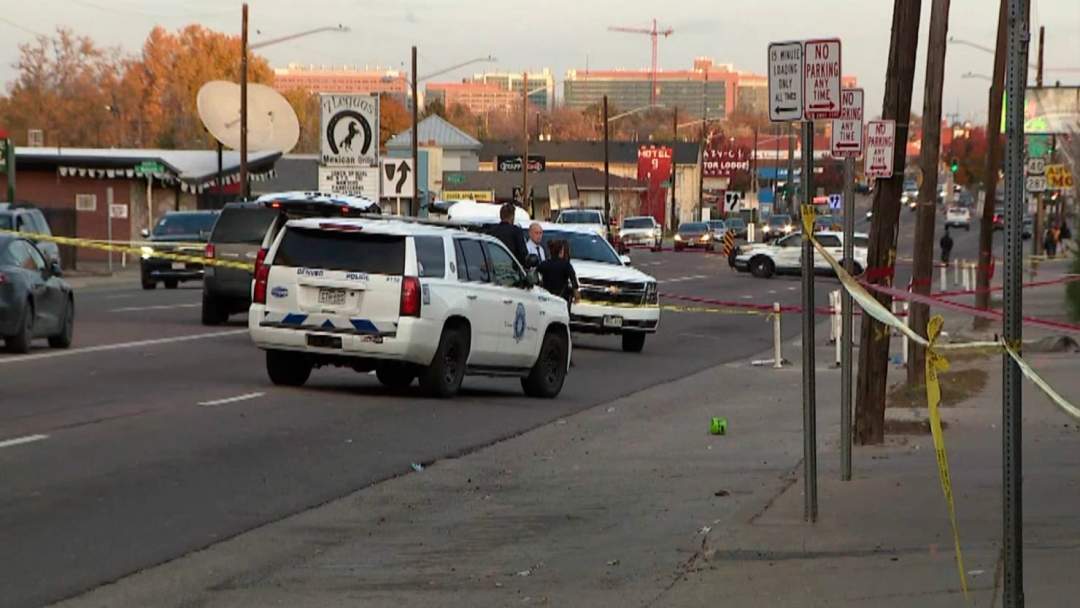
![A restaurant's takeout window area with a large jagged hole smashed through the glass, tables and string lights visible inside. [Radical Edward - Untelevised Media]](https://cdn.sanity.io/images/ypejdt32/articles/6ce43fc29caba434d5be0701130cda948f122c1a-1030x691.png?fit=max&auto=format&w=1080&q=65)
![Blue jeep speeds towards back side of protest as several people throw items at the jeep. [Radical Edward - Untelevised Media]](https://cdn.sanity.io/images/ypejdt32/articles/f2de88c49a3b489332d4bf072cdb9e77238d076a-579x386.jpg?fit=max&auto=format&w=1080&q=65)