
There is a black Donna Karan dress that has been hanging in evidence limbo for nearly three decades. It was worn by a woman who says she was sexually assaulted in a Bergdorf Goodman dressing room in the mid-1990s. She kept it. She didn't wash it. And when forensic experts finally examined it more than twenty years later, they found what she had always insisted was there: his DNA — or at least, the DNA of a male who had been on that dress, on her shoulders, on her sleeves, embedded in the fabric alongside her own skin cells.
The dress is real. The DNA mixture is real. The civil verdicts against Donald Trump are real — $88.3 million in total damages across two trials. What is not real, what has never been permitted to become real, is the one thing that could close the loop: a court-ordered comparison between the male DNA on that dress and a sample taken from the former president of the United States.
For three years, Trump refused. When he finally offered, it came with strings that no judge would accept. And then the trial proceeded without the DNA evidence — not because it didn't exist, but because the system allowed the most powerful man in the world to keep his genetic profile out of a courtroom.
But there is a deeper question, one that connects the Carroll dress to the sprawling Jeffrey Epstein scandal and to a national DNA database that holds the genetic fingerprints of millions of convicted felons. It is a question about what Donald Trump may have actually been protecting when he fought so hard to keep his DNA out of the Carroll case — and whether that fight had less to do with E. Jean Carroll than with something far more consequential sitting inside the FBI's Combined DNA Index System, waiting for a match.
The DNA on the Dress
The forensic findings in the Carroll case are precise and, for anyone familiar with how DNA evidence works, deeply suggestive.
When E. Jean Carroll brought her black Donna Karan dress forward as evidence, it was sent to a private laboratory for analysis. The results, later summarized in court filings and media reports, revealed a DNA mixture on the garment. Carroll's own DNA was present — expected, since she wore the dress. But the mixture also contained DNA from at least one unidentified male contributor. The male DNA was found on the shoulder and sleeves of the dress, consistent with physical contact — someone's hands gripping, pulling, or restraining.
The lab also identified skin fragments in the mixture. This is significant. Skin cells shed through friction, and their presence on the shoulder and sleeves of a dress that the wearer says was torn during an assault is precisely the kind of trace evidence that criminal prosecutors use to place a suspect at the scene of a crime.
But there is an important caveat, and it must be stated plainly: no sperm cells were detected on the dress. This does not disprove assault — the vast majority of sexual assaults do not result in detectable sperm, particularly when the assault involves manual contact or when the victim cleans up afterward. It does, however, narrow the forensic picture. The DNA on that dress came from skin-to-fabric contact, not from seminal fluid.
What that means in practice is this: the male DNA on the dress could theoretically belong to anyone who ever handled the garment — a dry cleaner, a friend, a store clerk. This is the argument Trump's attorneys made, and it is not without merit. The counterargument is equally straightforward: Carroll said the dress was worn once, during the assault, and then stored unwashed in a closet. If that is true, the male DNA on the shoulder and sleeves almost certainly belongs to the man she says attacked her.
The only way to resolve that question is through comparison. And for three years, that comparison was systematically blocked.
Three Years of Refusal
The timeline of Trump's DNA maneuvering reads like a masterclass in obstruction through legal process.
January 2020: Carroll's attorneys made their first request for a DNA sample from Trump, seeking to compare it against the male DNA found on the dress. The request was straightforward — a buccal swab, the same non-invasive cheek swab used in criminal cases across the country every day.
January 2020 through February 2023: For more than three years, Trump refused. His legal team argued that Carroll had "not demonstrated a reasonable basis for such an intrusive request," a striking position given that a court-admissible lab report had already confirmed the presence of unidentified male DNA on the very garment at the center of the lawsuit. The "intrusiveness" of a cheek swab — a procedure that takes seconds and involves no needles, no blood, no discomfort — was elevated to the level of a constitutional crisis.
February 2023: Suddenly, Trump changed tactics. His attorneys informed the court that he was willing to provide a DNA sample — but only if Carroll's lawyers turned over the full, unredacted DNA report on the dress first. This was not a good-faith compromise. It was a quid pro quo designed to force Carroll's legal team to disclose their evidence before receiving anything in return, potentially compromising their ability to assess the report's implications before trial.
Judge Lewis A. Kaplan, the federal judge presiding over the case, saw through it immediately. In a blistering order, Kaplan rejected the offer:
"His conditional invitation to open a door that he kept closed for years threatens to change the nature of a trial for which both parties now have been preparing for years."
Kaplan then made a ruling that effectively sealed the DNA question forever — at least in the Carroll case:
"There is no DNA evidence in this case, and none will be introduced at trial."
The Carroll II trial proceeded in April 2023 without the DNA evidence. The jury, presented with Carroll's testimony, Trump's recorded admission (the Access Hollywood tape), and the testimony of two other women who alleged similar assaults by Trump, found him liable for sexual abuse and defamation and awarded $5 million in damages. In January 2024, a second jury awarded Carroll an additional $83.3 million for continued defamatory statements Trump made about her. In June 2026, the Supreme Court declined to hear the case, letting the verdicts stand.
Trump, throughout, maintained that he had never met Carroll. "She's not my type," he said repeatedly. A photograph from 1987, later surfaced and widely circulated, showed Trump and Carroll at a party, standing close, smiling. Trump's response to the photo was characteristically dismissive. He denied it showed what it clearly showed.
The DNA — the one piece of evidence that could have established physical contact beyond any reasonable doubt — was never tested against him. Not because it didn't exist. Not because it was inadmissible. But because the man it would implicate had the resources and the audacity to run out the clock, and the legal system let him.
The Epstein Web
To understand why Trump's refusal to submit DNA in the Carroll case might extend beyond Carroll, you have to understand the web he was navigating.
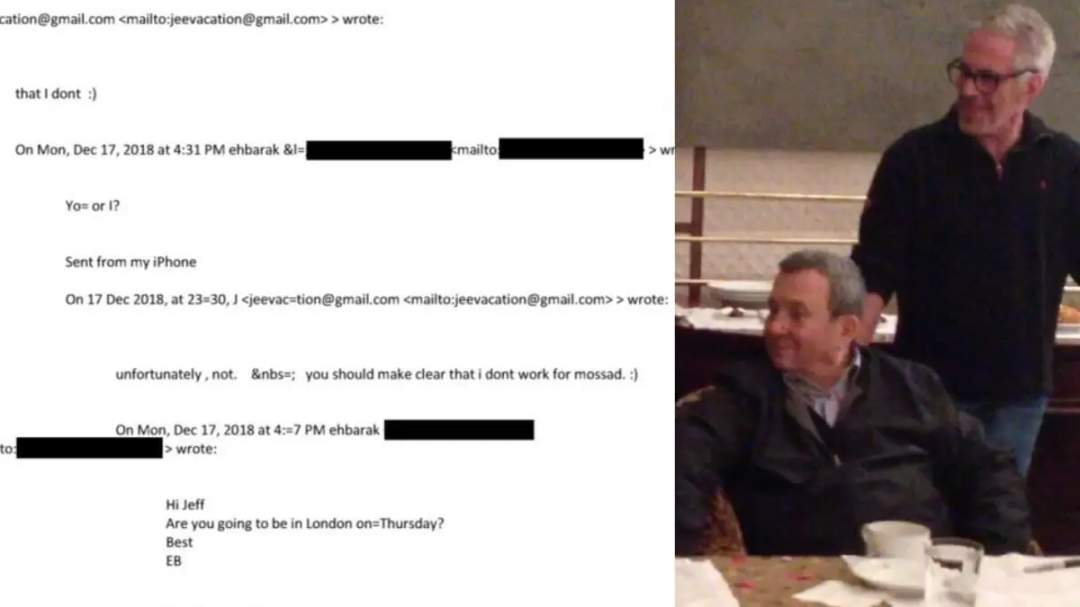
Donald Trump and Jeffrey Epstein were socially connected for more than two decades, from at least the 1980s through the mid-2000s. They appeared together at parties. They were photographed together. Trump told New York Magazine in 2002: "I've known Jeff for fifteen years. Terrific guy. He's a lot of fun to be with. It is even said that he likes beautiful women as much as I do, and many of them are on the younger side."
Epstein, of course, was later convicted in 2008 for soliciting prostitution from a minor in Florida — a plea deal widely criticized as egregiously lenient. He was arrested again in July 2019 on federal sex trafficking charges and died in his jail cell a month later. His death was ruled a suicide, though skepticism persists.
In 2016, during Trump's first presidential campaign, a woman identified only as "Jane Doe" (later reported to be Katie Johnson) filed a federal lawsuit alleging that Trump and Epstein had raped her when she was 13 years old at Epstein's Manhattan apartment in 1994. A second anonymous woman and a third anonymous witness corroborated elements of the account. The lawsuit was dismissed on procedural grounds and later voluntarily withdrawn by the plaintiff before it could be refiled — a withdrawal that Trump's allies have cited as exoneration, though voluntary dismissals can occur for many reasons, including safety concerns and legal strategy.
Then came the Epstein files.
In January and February 2026, the Department of Justice released batches of documents from the Epstein investigation, including FBI 302 interview memos from 2019. Among them: four interviews with a woman who told FBI agents that Epstein had repeatedly abused her starting around age 13, and that one of her abusers was Donald Trump. The woman was described as credible by investigators.
But the release was incomplete. An investigation by NPR found that the DOJ had initially withheld three of the four 302 memos from the public release, removing them before distribution. After media pressure, the DOJ released the missing memos in March 2026. CNN and other outlets reported on the seemingly selective withholding.
In July 2025, an FBI memo listed Trump's name at the top of a list of 14 prominent men connected to the Epstein investigation. The same memo indicated that Epstein had more than 1,000 victims — a figure that, if accurate, represents one of the largest sexual abuse operations in American history.
Trump's Attorney General, Todd Blanche, indicated that no additional criminal charges would result from the Epstein files — a decision that critics have called a conflict of interest given Blanche's prior role as Trump's personal defense attorney. As we documented in our investigation of Blanche's tenure, his installation at the DOJ has been a masterclass in using federal power to serve one client: the president.
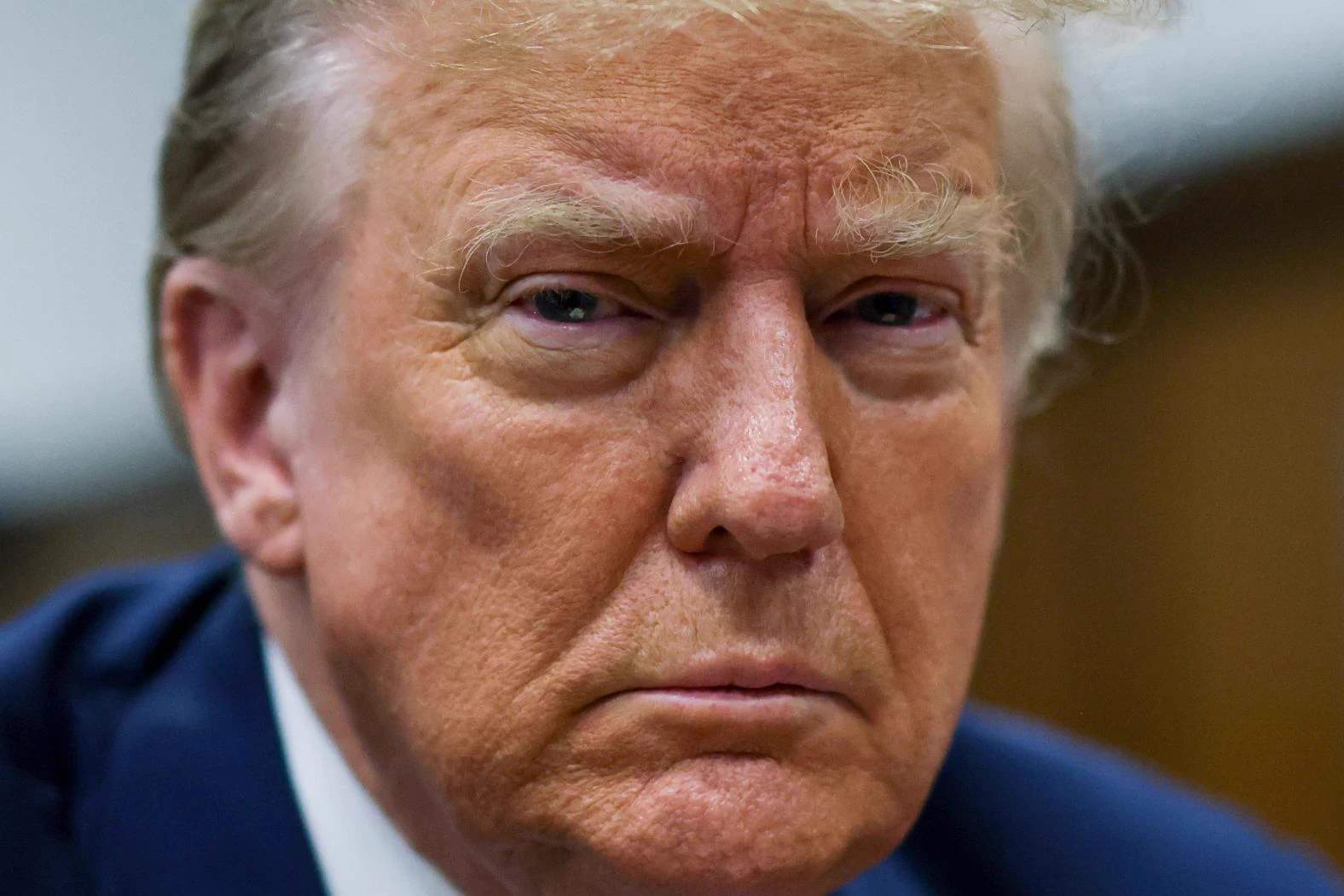
Donald Trump seated at a table inside a Manhattan courtroom surrounded by lawyers and security personnel during his hush money trial, April 2024
The CODIS Factor
This is where the Carroll dress and the Epstein scandal converge on a single point: Donald Trump's DNA profile.
Here is how it works.
CODIS — the Combined DNA Index System — is the FBI's national DNA database. It contains more than 17 million offender profiles and works by automatically cross-referencing new submissions against all existing profiles and forensic samples in the system. When a new offender profile is entered, CODIS runs it against every unsolved crime scene DNA sample on file. If there's a match, it flags it automatically. No warrant needed. No defense attorney present. The system does what databases do: it compares.
New York State law requires a DNA sample from every person convicted of a felony. The law is clear, the mechanism is straightforward: the local sheriff's office collects a buccal swab, the sample is sent to the New York State DNA Databank for processing, and the resulting profile is uploaded to CODIS through the National DNA Index System (NDIS).
In January 2025, Donald Trump was convicted of 34 felony counts — falsifying business records to conceal hush money payments to adult film actress Stormy Daniels. Under New York law, that conviction triggers a mandatory DNA collection requirement. This is the same administration that has systematically dismantled every check on its power — from congressional oversight to international law — making the absence of that cheek swab less an administrative oversight and more a feature of a larger architecture of impunity.
| Step | Authority | Action |
|---|---|---|
| 1 | NY County Sheriff's Office | Collect buccal swab sample |
| 2 | NY State DNA Databank (Albany) | Process sample, generate profile |
| 3 | NDIS/CODIS (FBI) | Upload profile, run automatic cross-reference |
| 4 | CODIS | Match against all crime scene DNA on file |
But here is the remarkable thing: there is no public documentation that the New York County Sheriff has collected Trump's DNA sample. The conviction happened. The sentencing happened. The Supreme Court declined to intervene. And yet, the one consequence of a felony conviction that could open a Pandora's box of other cases — the DNA swab — appears to have vanished into procedural ambiguity.
If Trump's DNA were collected and entered into CODIS, the system would automatically cross-reference it against every forensic sample in the database. That includes rape kits — thousands of them, from cases across the country, many involving unidentified male DNA. It includes any samples connected to the Epstein investigation, where multiple victims have alleged abuse by prominent men whose identities were never confirmed through forensic testing.
The Carroll dress DNA was tested by a private lab for the civil case and was never uploaded to CODIS. But other Epstein-related evidence — rape kits from victims, DNA from crime scenes, trace evidence from Epstein's properties — may well be in the system. And any of it could match.
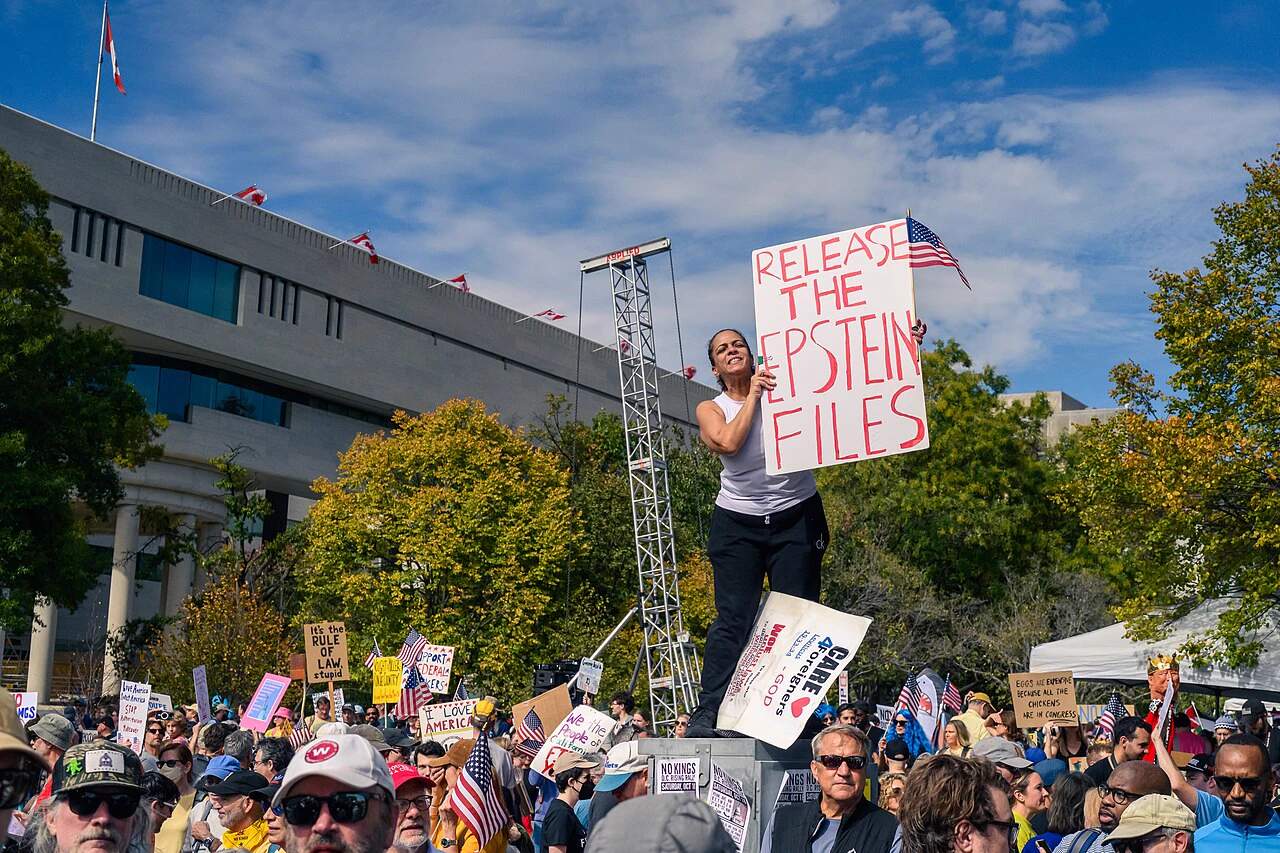
Protesters holding signs outside a government building demanding the release of the Epstein investigation files
The Unanswered Question
So let us state the theory plainly, because no one else seems willing to.
Donald Trump refused to submit a DNA sample in the E. Jean Carroll case for three years, then offered a bad-faith compromise when cornered, because he feared the consequences of comparison — not just in the Carroll case, but in any case where his DNA might match unidentified male evidence already in the system.
This is, admittedly, an inference. It is not proven. But it is an inference supported by a specific and documented set of facts:
- Male DNA was found on the dress at the center of the Carroll case, in locations consistent with physical assault.
- Trump refused for three years to provide a sample for comparison — a refusal that extended well beyond any reasonable legal strategy.
- Trump is socially and legally connected to Jeffrey Epstein, a sex trafficker with over 1,000 identified victims.
- Multiple women have accused Trump of sexual assault or rape, including a woman who alleged she was 13 years old when Trump and Epstein assaulted her.
- FBI interview memos from the Epstein investigation reference a victim who identified Trump as one of her abusers.
- Trump is now a convicted felon under New York law, which mandates DNA collection — but there is no evidence the sample has been taken.
- If his DNA entered CODIS, it would automatically be checked against every rape kit and crime scene sample in the national database.
Any one of these facts, taken alone, could be dismissed. A DNA mixture on a dress could belong to anyone. A refusal to submit a sample could be a legal tactic. An Epstein connection could be coincidental social overlap. A missing DNA swab could be administrative delay.
Taken together, they form a pattern — a pattern of a man who has been accused of sexual misconduct by more than two dozen women, who was publicly connected to one of history's most prolific sex traffickers, who was named in FBI memos connected to that trafficker's victims, and who has fought at every turn to keep his genetic profile out of any system that might hold him accountable.
The Call
The question is not whether Donald Trump is guilty of sexual assault in the Carroll case — a civil jury has already answered that. The question is not whether he knew Jeffrey Epstein — the photographs answer that. The question is why, in a country that compels DNA samples from teenagers convicted of minor drug offenses, the most powerful man in the world has been permitted to keep his DNA out of the one system designed to match perpetrators to victims.
The New York County Sheriff's Office has the authority to collect the sample. New York State law mandates it. The FBI's CODIS system would do the rest — automatically, without political interference, without editorial spin, without anyone needing to make an accusation.
A cheek swab takes ten seconds. The processing takes weeks. The cross-referencing is automatic. If there is nothing to hide, there is nothing to fear.
E. Jean Carroll put it this way:
"Unidentified male DNA on the dress could prove that Donald Trump not only knows who I am, but also that he violently assaulted me in a dressing room at Bergdorf Goodman and then defamed me by lying about it and impugning my character."
She is right. But the DNA on that dress may also answer questions about cases that have nothing to do with Bergdorf Goodman — questions about Epstein's victims, about rape kits sitting in evidence lockers, about a database that holds the truth in coded genetic sequences, waiting for the one sample that could unlock it all.
The dress is still out there. The DNA is still on it. And the man who left it there — if he is the man she says he is — has spent three decades and millions of dollars making sure that sample never sees the inside of a courtroom.
That refusal tells you everything you need to know.
Sources & Methodology(10 sources)
- NPR — Missing Epstein Files Related to TrumpNews Article
- Forbes — Trump DNA Swab Upon SurrenderNews Article
Methodology
This article draws on court filings from E. Jean Carroll v. Donald J. Trump (Southern District of New York), FBI 302 interview memos released by the Department of Justice in January-March 2026, FBI memoranda from July-November 2025, and published reporting from The Guardian, NBC News, NPR, CNN, AP, USA Today, Forbes, Politico, and other outlets. Legal timelines were cross-referenced with court dockets. DNA and CODIS procedures are based on New York State law and FBI NDIS/CODIS program documentation. No classified or unreleased material was used.
Frequently Asked Questions
- Was DNA found on E. Jean Carroll's dress?
- Yes. A private lab found a DNA mixture on the black Donna Karan dress that included Carroll's DNA and at least one unidentified male contributor. Skin fragments and male DNA were detected on the shoulder and sleeves. No sperm cells were found.
- Why wasn't Trump's DNA compared to the dress evidence?
- Trump refused to provide a DNA sample for three years. When he finally offered in February 2023, it was conditional on Carroll's lawyers turning over their full DNA report first. Judge Lewis Kaplan rejected the offer as a delay tactic and ruled that no DNA evidence would be introduced at trial.
- What is the connection to the Epstein case?
- Trump was socially connected to Jeffrey Epstein for decades. FBI 302 memos from 2019, released in 2026, reference a victim who identified Trump as one of her abusers starting at age 13. An FBI memo from July 2025 listed Trump's name at the top of a list of 14 men connected to the Epstein investigation, which documented over 1,000 victims.
- Could Trump's DNA be entered into the CODIS database?
- Yes. New York State law requires DNA collection from all felony convicts. Trump was convicted of 34 felony counts in January 2025. If the NY County Sheriff collects his sample, it would be uploaded to CODIS, which would automatically cross-reference it against all crime scene DNA on file nationwide, including rape kits from the Epstein investigation.
- Was the Carroll dress DNA uploaded to CODIS?
- No. The dress was tested by a private laboratory for the civil case and the results were never uploaded to the FBI's CODIS database. The DNA remains available for comparison if a court were to order Trump's sample.