

1. Between 15 and 18 People Die of Starvation Every Minute
The statistics on world hunger are staggering. We could write an entire article on this topic alone and only scratch the surface. Nearly 800 million people don't have enough food to maintain a healthy lifestyle, and roughly 700 people die of hunger every hour on average. Children are the most susceptible to death from starvation — in 2011, 3.1 million children died from starvation, accounting for 45% of all child deaths worldwide. Don't be fooled into thinking this is only a developing-world issue, either: 15.3 million children lived in food-insecure households in the U.S. in 2014, and in 2013 the five states with the highest rate of food-insecure children under 18 were D.C., Mississippi, Arkansas, New Mexico, and Georgia. Hunger is preventable — the world produces more than enough food to feed everyone. Just look at the USDA's Food Loss Report for 2014, or the fact that the United States ranks #1 in food waste.

A malnourished child crouches against a wall, eating scraps of food off the ground.
2. In 2009, the U.S. Poverty Rate Broke 25% of the Population
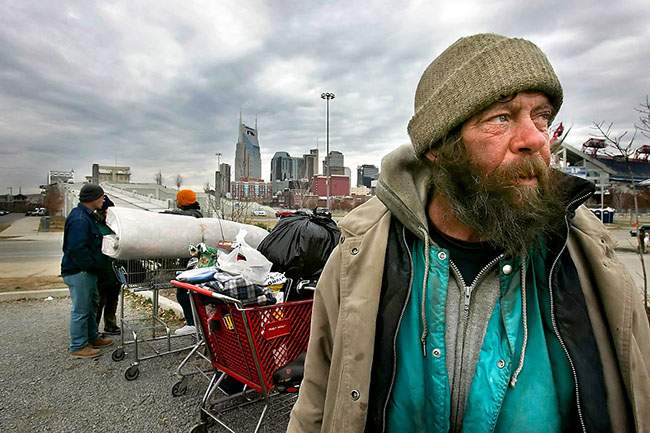
A homeless man with a beard stands beside overloaded shopping carts, with the Nashville skyline in the background.
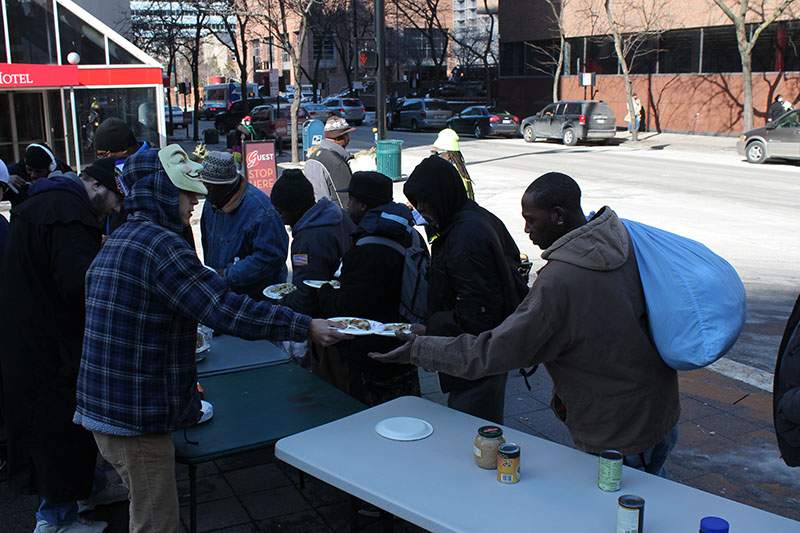
In 2011, the number of Americans living below the official poverty line was 46.2 million — a 5.6% increase from 2010, and 14.5% of the population. "It was the first time since the Great Depression that median household income, adjusted for inflation, had not risen over such a long period," said Lawrence Katz, an economics professor at Harvard. Single parents make up 47% of all U.S. citizens living in poverty (31% single mothers, 16% single fathers), with children accounting for another 21%. In January 2014, roughly 578,000 Americans were experiencing homelessness — sleeping outside or in an emergency shelter or transitional housing program — 50,000 of whom were military veterans.
3. If You Can Afford Three Meals a Day for Three Weeks, You're in the Wealthiest 15% on Earth
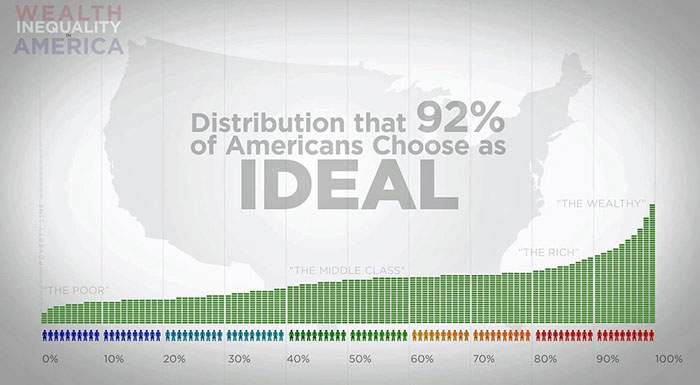
Bar chart titled 'Distribution That 92% of Americans Choose as Ideal,' showing a gently sloped wealth distribution from poor to wealthy.
Some of us are fortunate enough to have the resources to choose how we live and support our families, unlike those who struggle every day just to survive. The distribution of wealth around the world is grossly unjust: more than half of the world’s wealth sits in the hands of the top 1%, leaving just 5.9% of global wealth for the bottom 80% of the planet. That places roughly 40% of the world’s wealth with about 20% of its population — the bottom of whom still don’t have enough to sustain themselves properly on a daily basis. Combined with fact #1, this shows the problem isn’t a lack of resources, shelter, or food. The problem is greed and the hoarding of the world’s wealth — facts that also debunk theories like the "trickle-down effect."
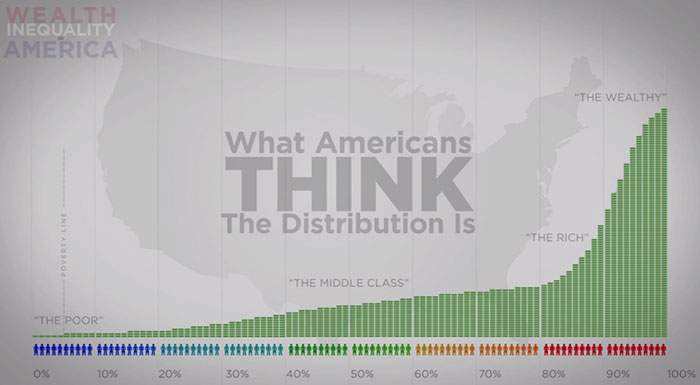
Bar chart titled 'What Americans Think the Distribution Is,' showing wealth concentrated toward the top with a moderate curve.
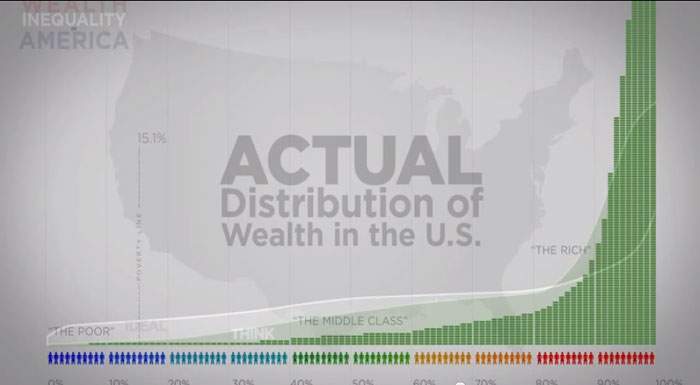
Bar chart titled 'Actual Distribution of Wealth in the U.S.,' showing wealth sharply concentrated among the top few percent.
4. Americans Spend Almost $60 Billion a Year on Pets — Ending World Hunger Would Cost $30 Billion
That's right — the money Americans spend on pet care could end world hunger twice over. Total U.S. pet industry expenditures were an estimated $60.59 billion in 2015 ($58.04 billion actual in 2014), including $22.26 billion spent on pet food alone — almost enough on its own to end world hunger. The $30 billion figure for ending world hunger comes from The Borgen Project and is accepted by the United Nations. We're not advocating that anyone starve their pets — we're merely stating facts. But if you can justify that expense for an animal, perhaps you can justify giving half of it to help other humans. The Borgen Project also compares the figure to the U.S. defense budget — $600 billion a year and rising. Both comparisons make the cost of ending world hunger look pretty obtainable.

A cat lies on a carpet surrounded by scattered U.S. dollar bills.
5. 1 in 9 People Didn't Get Enough to Eat Today
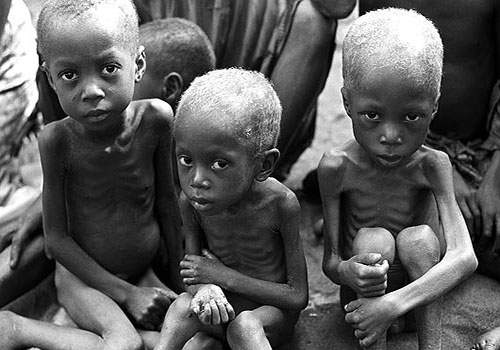
Three malnourished children sit close together, looking at the camera.
Some 795 million people worldwide don't have enough food to lead a healthy, active life. Don't let the imagery fool you into thinking this is only a problem elsewhere — it happens in America too. Americans living in poverty struggle to find their next meal as well; urban neighborhoods with pervasive unemployment and poverty are home to the hungriest. The South Bronx has the highest rate of food insecurity in the country, at 37%, compared with 16.6% for New York City as a whole.
Global undernourishment has fallen sharply since the early 1990s, but the numbers remain enormous:
| Region | 1990–92 (millions) | 1990–92 (%) | 2014–16 (millions) | 2014–16 (%) |
|---|---|---|---|---|
| World | 1,010.6 | 18.6 | 794.6 | 10.9 |
| Developed regions | 20.0 | <5 | 14.7 | <5 |
| Developing regions | 990.7 | 23.3 | 779.9 | 12.9 |
| Africa | 181.7 | 27.6 | 232.5 | 20.0 |
| Sub-Saharan Africa | 175.7 | 33.2 | 220.0 | 23.2 |
| Asia | 741.9 | 23.6 | 511.7 | 12.1 |
| Eastern Asia | 295.4 | 23.2 | 145.1 | 9.6 |
| South-Eastern Asia | 137.5 | 30.6 | 60.5 | 9.6 |
| Southern Asia | 291.2 | 23.9 | 281.4 | 15.7 |
| Latin America & Caribbean | 66.1 | 14.7 | 34.3 | 5.5 |
| Oceania | 1.0 | 15.7 | 1.4 | 14.2 |
Source: FAO, The State of Food Insecurity in the World 2015, p. 8.
6. There Are About 1.7 Million Homeless Teens in the U.S. — 39% of the Homeless Population Is Under 18

A man sits hunched against a wall next to a cardboard sign reading 'Homeless, hungry, sick and tired. Anything helps. I have no one.'
According to HUD's 2014 Point-in-Time Report, 34% of the total homeless population is under 24. While most homeless minors are with family, 45,205 teens were unaccompanied and fending for themselves in 2014 alone. Approximately 40% of homeless teens identify as LGBT, and family rejection based on sexual orientation or gender identity is the most frequently cited factor contributing to LGBT homelessness (46%). More than half of young people in shelters and on the streets report that their parents told them to leave, or knew they were leaving and didn't care. A 2002 report on sexual abuse among adolescent runaways, prepared for the U.S. Department of Health and Human Services, found that 21–40% of homeless youth had been sexually abused, compared with 1–3% of the general youth population. Of youth who run away, 41% have been abandoned by their parents for at least 24 hours, and 43% have been beaten by a caretaker.
7. The United States Has One of the Largest Gaps Between Worker and Executive Incomes of Any Wealthy Nation
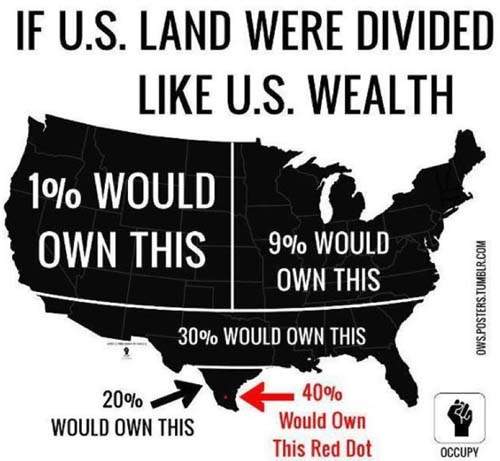
Infographic titled 'If U.S. Land Were Divided Like U.S. Wealth,' showing the U.S. map split into unequal regions labeled by the percentage of the population that would own each share.
Since the 1970s, the top 1% of earners in the U.S. have roughly doubled their share of total American income, to nearly 20% from about 10%. The wealth share of the top 3% rose from 44.8% of the nation's wealth in 1989 to 51.8% in 2007 and 54.4% in 2013 — the top 3% now hold more than double the wealth of America's poorest 90% of families combined. Perhaps the most visible indicator of wealth inequality today is the Forbes 400 list. In 1982, the year Forbes began publishing its annual list of America's 400 richest people, the U.S. had only 13 billionaires. Making the 2014 Forbes 400 required a fortune of at least $1.55 billion.
8. 20% of the World's Population Lives on Less Than $1 a Day
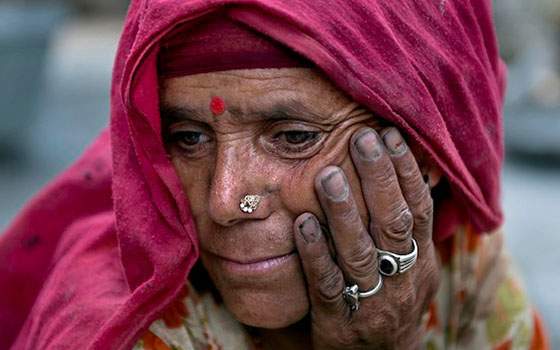
An elderly woman in a red headscarf rests her face in her hand.
Over the next 25 years, an estimated 50 million people will be added to the population of rich countries — but over the same period, about 1.5 billion people will be added to the population of poor countries. More than one billion people worldwide live on less than one dollar a day, and in total, 2.7 billion struggle to survive on less than two dollars a day. Poverty in the developing world goes far beyond income alone.
9. 40% of Americans Now Earn Less Than the Inflation-Adjusted 1968 Minimum Wage
Back in 1968, the U.S. minimum wage was $1.60 an hour. That sounds small, but after accounting for inflation, a very different picture emerges. Using the Bureau of Labor Statistics' inflation calculator, $1.60 in 1968 is equivalent to $10.74 today. Working full-time at $10.74 an hour for a year (with two weeks off) comes to about $21,480 a year. That isn't much — but according to the Social Security Administration, 40.28% of all U.S. workers make less than $20,000 a year today. That means more than 40% of American workers actually earn less than a full-time minimum-wage worker did back in 1968. That's how far we've fallen.

A U.S. one-dollar bill edited so George Washington's portrait shows a shocked, hands-on-face expression.
10. The Gap Between Rich and Poor in the United Kingdom Has Reached Its Highest Level in 40 Years
Excluding Iceland, Norway, and the Faroe Islands (which aren't part of the EU and weren't included in the study), 9 of the 10 poorest regions in Northern Europe are in the UK. West Wales is the poorest region, followed by Cornwall, Durham, Lincolnshire, Northern Ireland, and East Yorkshire — 18 million people can't afford adequate housing as poverty rises from 14% to 33%. By comparison, the richest area in the EU is Inner London: on a scale where 100 represents the average wealth per person across the EU, Inner London scores 303, while Outer London sits just above average at 108.5. Elsewhere in the country, Cornwall rates 77.4, while Berkshire, Buckinghamshire, and Oxfordshire score 168. We'll just leave these images here to sum it up.

Overflowing rubbish bins line a residential street in the UK as two children walk past with a bicycle.

Queen Elizabeth II inspects rows of stacked gold bars during a visit to a bank vault.
Sources & Methodology(25 sources)
- World Food Programme — Hunger StatsNews Article
- poverty.comNews Article
- Feeding America — Child Hunger Fact SheetNews Article
- USDA Food Loss Report 2014News Article
- FAO — Save Food Key FindingsNews Article
- The New York Times — 2011 Census Poverty ReportNews Article
- Federal Safety Net — U.S. Poverty StatisticsNews Article
- HUD — Veteran Homelessness Press ReleaseNews Article
- The Borgen Project — Cost to End World HungerNews Article
- National Priorities Project — Military SpendingNews Article
- National Geographic — Hunger in AmericaNews Article
- DoSomething.org — Facts About Homeless TeensNews Article
- HuffPost — Income Inequality and Wall StreetNews Article
- Forbes 400News Article
- World Bank — Reducing PovertyNews Article
- UN Millennium Project — Fast FactsNews Article
- Daily Mail — Inner London Richest in the EUNews Article
Methodology
Originally published on Anon Resistance News (news.anonresistance.dx.am) in 2015; migrated to UnTelevised Media as part of the ARN archive project. Co-authored with Edward Dawson (writing as Radical Edward).
Frequently Asked Questions
- How many people die of starvation every minute?
- Between 15 and 18 people die of starvation somewhere in the world every minute, according to the global hunger statistics cited in this article.
- How much do Americans spend on pets compared to what it would cost to end world hunger?
- Americans spend an estimated $60 billion a year on pet care — roughly twice the $30 billion The Borgen Project and the United Nations estimate it would cost to end world hunger.
- What percentage of the world's population lives on less than $1 a day?
- About 20% of the world's population lives on less than one dollar a day, and 2.7 billion people survive on less than two dollars a day.
- How many homeless teens are there in the United States?
- There are an estimated 1.7 million homeless teens in the United States, and 39% of the overall homeless population is under 18.