
Who Is Tyler E. Brown? The Full Profile of the Cambridge Memorial Drive Gunman
A Three-Decade Crime Spree, Institutional Failure, and the People Who Tried to Help
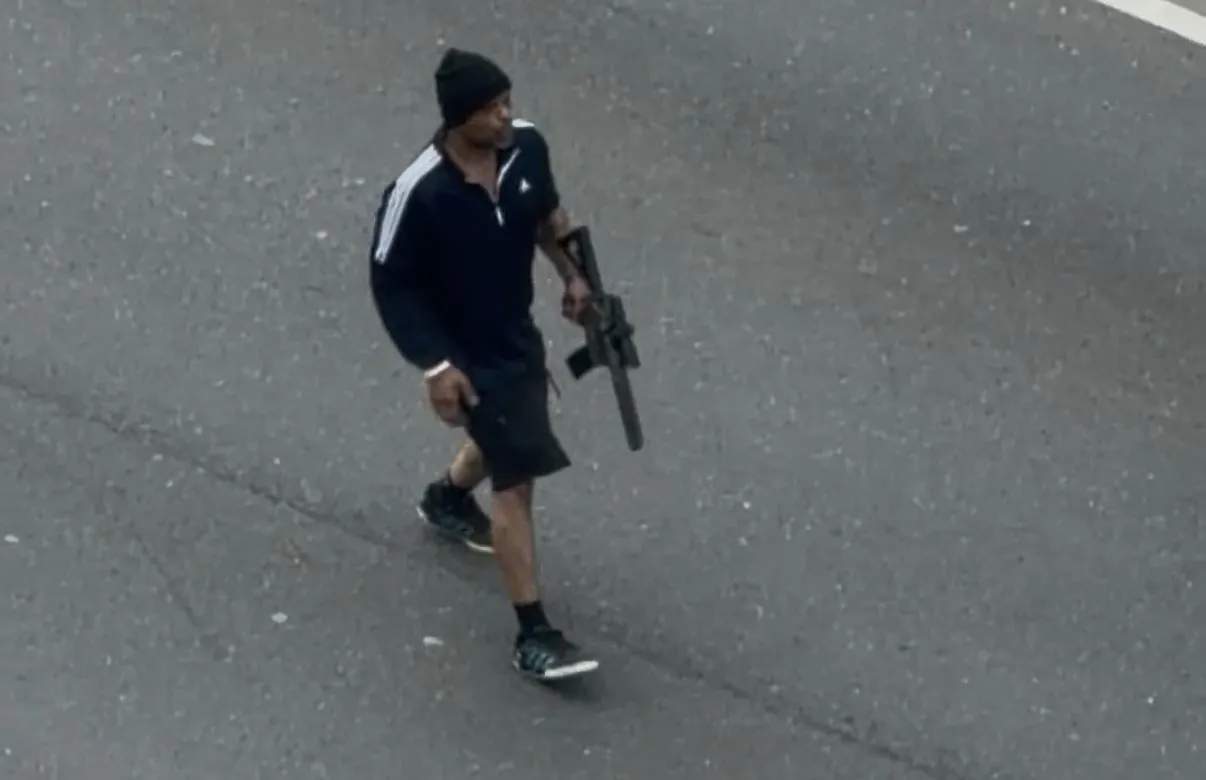
On May 11, 2026, Tyler E. Brown walked down the middle of Memorial Drive in Cambridge, Massachusetts, and opened fire with a semi-automatic rifle. He fired more than 60 rounds into passing traffic, critically injuring two people — an MBTA driver and a DoorDash delivery man, both innocent men going about their day. The rampage ended when a Massachusetts State Police trooper and an armed former Marine confronted Brown and shot him in the extremities.
The mainstream media covered the shooting itself in exhaustive detail. But who is Tyler E. Brown? Where did he come from? Who are the people and institutions connected to him? And how did a man with a 30-year criminal history that includes shooting at police officers end up free on the streets of Boston just three days after being discharged from a psychiatric hospital?
This is the story the mainstream press didn't fully tell.
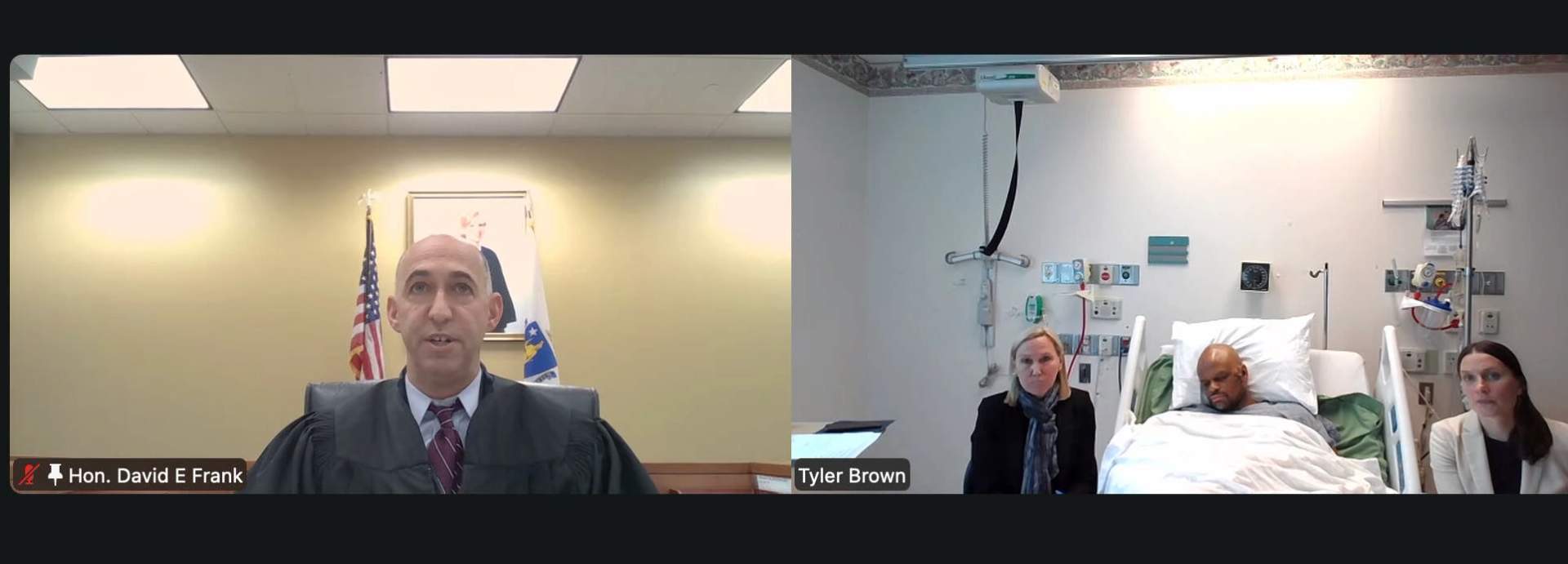
Tyler E. Brown lying in a hospital bed during his virtual arraignment in Cambridge District Court on May 14, 2026
The Criminal Record: A Timeline of Violence
Tyler E. Brown's criminal history spans three decades and at least two states. Court records, police reports, and sentencing transcripts paint a picture of a man who was failed by nearly every institution that touched him — but who also inflicted harm on everyone around him.
This isn't an isolated pattern. As we've documented before, when the system fails people repeatedly, some of them build their own justice — or tear down everything around them
1994: Armed Robbery in Michigan (Age 14-15)
Brown's first known conviction came when he was a teenager in Michigan, where he was convicted of armed robbery. Three years later, in 1999, he was convicted of escaping from a Michigan jail — using violence — while serving time on that original armed robbery sentence. These early convictions established a pattern that would repeat for the rest of his life.
2007: New Hampshire Drug Charges
After his release, Brown was arrested in New Hampshire on two separate drug-related cases. He was sentenced to one year with 203 days to serve for possession of Class C drugs, and one-and-a-half to three years for a second drug possession charge. He was arrested just months after the birth of his first son.
2008: Revere Drug Distribution and Brockton Firearms
In September 2008, Brown was convicted of cocaine distribution in Revere, Massachusetts. Later that same year, he was arraigned in Brockton District Court on charges of carrying a firearm without a license, carrying a loaded firearm without a license, and possession of a firearm without an FID card. He pleaded guilty in January 2009 and was sentenced to 18 months in the House of Correction. This Brockton firearms case was later dismissed due to the Massachusetts state drug lab scandal — the Annie Dookhan and Sonja Farak cases that threw thousands of convictions into doubt and reduced mandatory minimum sentences for countless defendants.
2014: The Knife Attack and Witness Intimidation
In July 2014, Brown was arraigned in Boston Municipal Court's Charlestown Division on charges of assault with a dangerous weapon, assault and battery, and disorderly conduct. He was ordered held without bail because the crimes had been committed while he was already out on bail on an earlier case — a theme that would recur throughout his life. He pleaded guilty to assault and battery in December 2016 and was sentenced to two years and six months.
But the more serious 2014 case came later that year. Brown was charged with two counts of assault and battery with a dangerous weapon, five counts of assault with a dangerous weapon, and one count of witness intimidation in a knife attack against several people. He was initially found incompetent to stand trial due to mental illness and was sent to Bridgewater State Hospital for psychiatric evaluation. He was eventually deemed competent and pleaded guilty in December 2016 to all charges. Judge Rosalind H. Miller sentenced him to six years in state prison.
2020: The Shootout with Boston Police
On May 16, 2020 — almost exactly six years before the Memorial Drive shooting — Brown confronted people who were moving into a Roxbury apartment. "Where are you from?" he demanded. "Call your boys," he said before pulling a gun from a bag. When Boston Police officers responded to the scene on Northampton Street in the South End, Brown opened fire. He fired at least 13 rounds at four officers. No one was injured.
Brown was out on probation at the time for the 2014 knife case and had failed a drug test. He was arrested at the scene, shouting "Finish this" repeatedly — statements that law enforcement experts later said indicated suicidal ideation.
Brown ultimately pleaded guilty to eight charges, including armed assault with intent to murder and attempted assault and battery by means of discharging a firearm. Then-Suffolk County District Attorney Rachael Rollins pushed for a sentence of 10 to 12 years. Judge Janet Sanders instead imposed a sentence of five to six years, citing the dismissed drug lab case that had reduced mandatory minimums, Brown's completion of a GED and college credits, and letters of support from Boston City Hall.
One of the officers involved wrote a victim impact statement that proved prophetic: "I am a firm believer that when Mr. Tyler Brown gets out, he will hurt, or worse, kill someone."
Judge Sanders acknowledged she was taking a gamble. "I can't look into a crystal ball," she told Brown from the bench. "I do understand that I am taking a risk here."
2026: Memorial Drive
On May 11, 2026, Brown proved the officer right. Less than two hours before the shooting, his parole officer called 911 to report that Brown was suicidal, armed with a semi-automatic rifle, and high on crack cocaine. Brown called the officer on FaceTime, waving the rifle and saying, "These people are gonna fucking pay." He told the officer he was "no longer being Tyler Brown" and was "now repping his shooter name." He claimed to have committed other murders he was never caught for.
The parole officer obtained a warrant, tracked Brown's phone to Cambridge, and within hours, Brown was walking down Memorial Drive firing 60 to 70 rounds at random cars and pedestrians. Two men were critically wounded. Brown himself was shot multiple times by State Trooper Landon Veney and a former Marine who happened to be driving by with a 9mm Glock in a safe in his backseat.
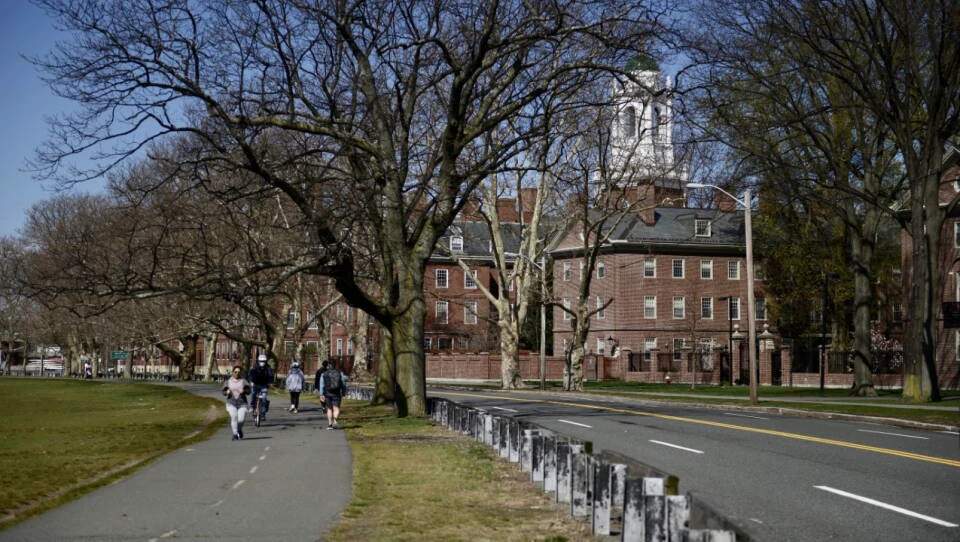
Police presence on Memorial Drive in Cambridge after the May 11, 2026 shooting
The Network: Who Tyler Brown Was Connected To
Family
Brown has two sons, born in 2007 and 2012, with the same partner. Court records from a 2017 visitation case reveal a complicated family picture. Brown described the months before his first son's birth as "nothing short of idyllic," but the relationship deteriorated as he struggled with substance abuse, unemployment, and increasingly erratic behavior.
Brown represented himself in the custody case — a fact that impressed Judge Janet Sanders at his 2021 sentencing, who called him "obviously gifted intellectually." He fought for and won regular phone calls and in-person visits with his children. He wrote that it was "neither healthy nor fair" for the children's relationship with their father to hinge on whether their mother was "mad" at him.
Brie's House
After his release from prison in May 2025, Brown lived at "Brie's House," a 12-room triple decker in Boston that serves as a rooming house for formerly incarcerated people. Residents described hearing Brown making music — playing keyboard — though they noted rumors of drug use in the weeks before the shooting. The owner of Brie's House declined to comment.
New Beginnings Reentry Services
Stacey Borden, executive director of New Beginnings Reentry Services and a friend of Brown's family, spoke with him just a week before the shooting. She described a man who was struggling. "He said he just couldn't — his living condition wasn't good. He just wasn't able to manage things with parole on his back," Borden said. "In his head, he kept seeing police and he was determined to not go back to jail."
Boston City Hall — The Mayor's Office of Returning Citizens
One of the most significant connections in Brown's story is to Kevin Sibley, then-executive director of the Mayor's Office of Returning Citizens under Mayor Michelle Walsh's administration. In letters dated January and November 2020, Sibley helped Brown develop a post-release plan that included employment and housing.
"So far, Mr. Brown has sought assistance with our partners at the Urban League, Community Works Servings, and he is looking into the construction apprenticeship program with Madison Park," Sibley wrote. "We believe that if Tyler is provided with the reliable opportunities for personal growth, he will be a valuable, contributing member of our community."
These letters were presented at Brown's 2021 sentencing and played a role in Judge Sanders' decision to impose a lighter sentence.
Tufts University Prison Initiative (TUPIT / MyTERN)
Perhaps the most prominent institutional connection: Brown was accepted into the Tufts University Prison Initiative's MyTERN (Tufts Education and Re-entry Network) program after his release. The yearlong re-entry program combines college coursework with housing, employment, and wraparound services, including an 18-credit Civic Studies certificate.
A photo posted on TUPIT's Instagram account shows Brown speaking at the program's annual Community Conversations Dinner in February 2026, wearing a light blue collared shirt and glasses, addressing the crowd. He stopped attending the program in February, according to Tufts officials. Patrick Collins, executive director of media relations at Tufts, confirmed Brown's participation and said the university was cooperating with law enforcement.
The Tufts Daily reported on the connection, and the university declined to comment further.
The Massachusetts Parole Board
The Massachusetts Parole Board released Brown on parole in May 2025, finding him "remorseful about the part he played in the offense" in the 2020 police shooting. He was ordered to abide by conditions including mental health treatment and drug testing. His parole was set to terminate at the end of May 2026 — just weeks after the Memorial Drive shooting. His probation would have continued beyond that date.
Critics, including the Boston Police Patrolmen's Union, posted on X that the 2020 sentence was a "ball drop." "The fact that the judicial system thought it prudent to show leniency to a wannabe cop killer five years ago is not only the definition of insanity but an undeniable insult to those who put their lives on the line everyday," the union wrote.
Judge Janet Sanders
Suffolk Superior Court Judge Janet Sanders is the judge who imposed the controversial five-to-six-year sentence in 2021 over prosecutors' requests for 10 to 12 years. She has not responded to requests for comment since the Memorial Drive shooting. At sentencing, she cited Brown's "network of support," his educational achievements, and letters from Boston City Hall as reasons for her leniency.
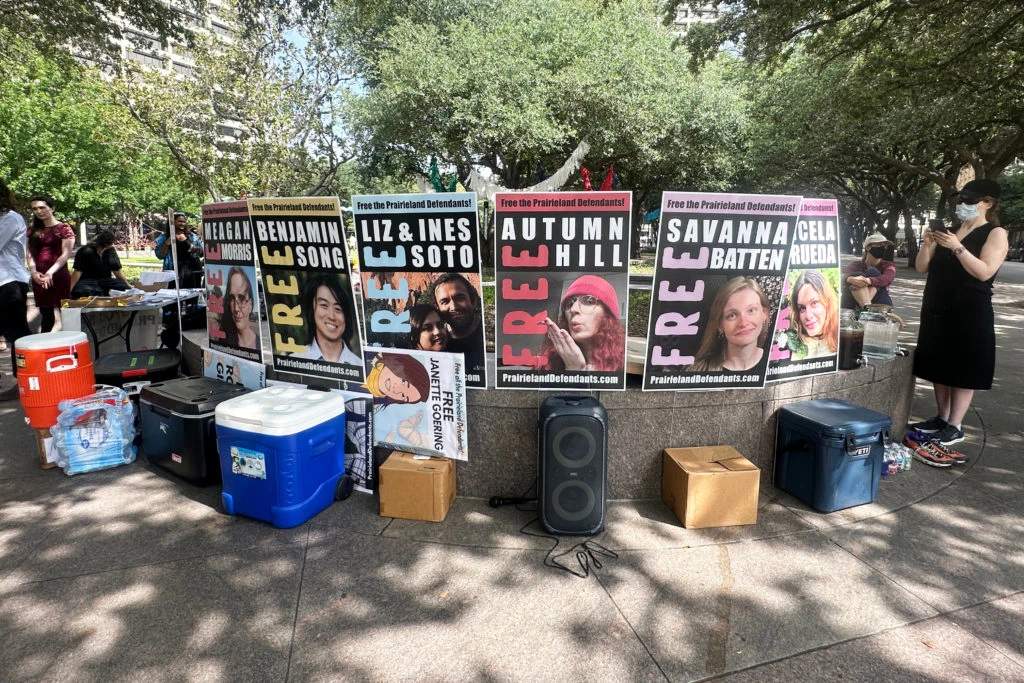
The same system that showed Brown leniency has shown no such restraint toward political dissidents. Antifa activists in the Prairieland case received 450 years combined for property crimes
McLean Psychiatric Hospital
Brown was admitted to McLean psychiatric hospital — one of the most prominent psychiatric facilities in the country, associated with Harvard Medical School — at some point before the shooting. He was discharged just three days before the Memorial Drive rampage, according to a Massachusetts State Police report.
Mental Health and Incarceration
Brown has been diagnosed with depression, anxiety, and post-traumatic stress disorder. His defense attorney in court papers attributed "a significant portion" of his psychiatric history to "prolonged isolation" at Souza-Baranowski Correctional Center, Massachusetts' highest-security prison. While incarcerated pending trial in the 2014 knife case, he was sent to Bridgewater State Hospital for psychiatric evaluation and was directed by court officials to be evaluated for suicidal ideation.
The system that was supposed to treat him instead deepened his illness. Then they turned him loose onto city streets time after time, crime after crime.
Music and Social Media
Residents at Brie's House reported that Brown made music — he played keyboard and could be heard composing in his room. A search for his name on Spotify yields a page under "Tyler Brown" with a track titled "Did What I Had To Do," though it has not been confirmed this is the same Tyler E. Brown.
No verified personal social media accounts belonging to Brown have been publicly identified at this time. The Instagram reel capturing his arraignment footage went viral, but no personal Facebook, Instagram, Twitter, or TikTok profiles tied to him have been confirmed by credible sources.
The Systemic Failures
Tyler E. Brown's story is not just about one man. It is about a cascade of institutional failures:
- A judge who ignored prosecutors' warnings and a victim impact statement that predicted exactly what would happen
- A drug lab scandal that reduced mandatory minimum sentences and gave judges cover for leniency
That kind of institutional erosion of accountability isn't limited to sentencing courts. At the federal level, Trump's pardon sprees have systematically dismantled anti-corruption oversight
- A parole board that released a man with a documented history of violence against law enforcement
- A psychiatric hospital that discharged a suicidal, armed man three days before he went on a rampage
- A parole system that knew he was relapsing on crack cocaine, had a rifle, and was threatening violence — but couldn't stop him in time
The failure to intervene before violence erupts mirrors what we've seen across the country, where militarized policing and institutional rot feed each other in a deadly feedback loop
- A reentry system that tried, through Tufts, Boston City Hall, and community organizations, but ultimately couldn't hold him together
And when the system does intervene, it often does so to protect the powerful — not the public. A South Carolina jury just acquitted a store owner who killed a 14-year-old Black teenager over bottled water
And yet: none of this changes the fact that Tyler Brown made choices. He chose to pick up a gun. He chose to fire into a crowd of innocent people on Memorial Drive. He chose to terrorize a community that had tried, through multiple programs and institutions, to give him a second chance — and a third, and a fourth.
The question isn't whether the system failed Tyler Brown. It clearly did. The question isn’t whether the system's failures or what Tyler did to Casimir Bangoura, to Felix — a father of eight — and to every person on Memorial Drive that day who had to run for their lives. The question is when do we hold them accountable for those systemic failures.
Sources & Methodology(12 sources)
- WBUR - After Memorial Drive shootings, questions linger on how alleged gunman slipped through the cracksNews Article
Deep investigation into Brown's history, sentencing, Brie's House, Stacey Borden, Kevin Sibley connections
- WBUR - Alleged Cambridge gunman released from psychiatric hospital 3 days before shootingNews Article
Details on McLean hospital discharge, parole officer call, FaceTime with rifle, timeline of shooting
Comprehensive profile including family, fatherhood, custody case, TUPIT, judge's reasoning
Arraignment details, dual supervision parole/probation charges, victims identified
- Boston Herald - Cambridge Memorial Drive shooting suspect Tyler Brown's lengthy rap sheetNews Article
Complete chronological rap sheet from 1996 Michigan through 2026
- CBS Boston - Accused Memorial Drive gunman Tyler Brown tried to kill Boston police in 2020News Article
2020 shooting details, Rachael Rollins reaction, sentencing, parole release date
5 Investigates piece on Brown's 2014 knife attack, Souza-Baranowski isolation, drug lab scandal
Criminal complaint charges, dual supervision, Joseph Bennet character witness
- Patch - Details of Cambridge Shooter Tyler Brown's Criminal History and Controversial Prison SentenceNews Article
Rachael Rollins statement on sentencing, probation details
TUPIT MyTERN program connection, Instagram post of Brown speaking at dinner, university statement
Official DA sentencing press release with charges and statement from Rachael Rollins
- Boston 25 News - Body camera video sheds new light on 2020 Boston police shooting involving Tyler BrownNews Article
Body camera footage, 'Finish this' quotes, expert analysis of mental health crisis
Methodology
Reported using court records, police reports, sentencing transcripts, Suffolk County DA press releases, and investigative reporting from WBUR, the Boston Globe, Boston Herald, CBS Boston, WCVB, NBC Boston, Patch, and the Tufts Daily. All claims cross-referenced across multiple sources.
Filed Under
Frequently Asked Questions
- Who is Tyler E. Brown?
- Tyler E. Brown, 46, of Boston, is the man accused of firing more than 60 rounds from a semi-automatic rifle on Memorial Drive in Cambridge, Massachusetts on May 11, 2026, critically injuring two people. He has a 30-year criminal history spanning Michigan, New Hampshire, and Massachusetts.
- What was Tyler Brown's prior criminal record?
- Brown's record includes a 1994 armed robbery conviction in Michigan, a 1999 jail escape using violence, 2007 New Hampshire drug convictions, a 2008 Brockton firearms case (later dismissed due to the state drug lab scandal), a 2014 knife attack and witness intimidation conviction, and a 2020 shootout with Boston Police for which he served five to six years in state prison.
- How was Tyler Brown connected to Tufts University?
- Brown was accepted into the Tufts University Prison Initiative's MyTERN reentry program after his release from prison in 2025. He was featured as a speaker at TUPIT's annual Community Conversations Dinner in February 2026. He stopped attending the program in February, according to university officials.
- Who were the victims of the Memorial Drive shooting?
- The two victims were identified by family members as Casimir Bangoura, a Cambridge resident driving to the car wash, and a man known only as Felix, a father of eight who worked as an MBTA Ride Services driver. Both suffered life-threatening injuries.
- Why was Brown's 2020 sentence controversial?
- Prosecutors requested 10-12 years for shooting at four Boston police officers. Judge Janet Sanders imposed only 5-6 years, citing the Massachusetts drug lab scandal that reduced mandatory minimums, Brown's educational achievements, and letters of support from Boston City Hall's Office of Returning Citizens. One officer wrote that Brown would 'hurt, or worse, kill someone' if released.